On this page
IBM MQ is priced by processor capacity, not by message volume or user count. The core unit is the Processor Value Unit (PVU) — a per-core rating that varies by chip type — multiplied across every core the software is entitled to run on, so the deployment's core count and processor choice, not traffic, set the bill. That single design choice explains most of what makes IBM MQ licensing feel unpredictable: two organizations running the same workload can land on very different numbers depending on hardware, virtualization approach, and which edition each queue manager is licensed under.
This is a straight explainer on how that pricing works and what actually moves the number — not a case for switching platforms. If you're separately weighing IBM MQ against an open-source broker, see IBM MQ vs RabbitMQ.
Licensing is one line of the bill; operating the queue managers is the other. AceMQ offers 24/7 IBM MQ support for teams that want senior MQ engineers on call without adding headcount.
What is a Processor Value Unit (PVU) and how does IBM MQ use it?
A Processor Value Unit is IBM's unit of software capacity. IBM publishes a table rating every supported processor family — vendor, brand, and model — at a certain number of PVUs per core, and that table is the sole source of truth for the rating. It changes as new processor generations ship, so a rating you used two procurement cycles ago is not guaranteed to still be current.
IBM MQ, like most of IBM's middleware — it shipped for years as WebSphere MQ before the name was shortened — is licensed against this metric: the server (or virtual machine) running each queue manager needs enough PVU entitlement to cover its eligible cores at their rated value. Historically, common x86 server cores have rated in the neighborhood of 70 PVU each, with high-end RISC and mainframe cores rating higher — but treat any specific number as illustrative rather than current pricing, and confirm the live rating on IBM's Passport Advantage PVU table before it goes into a budget line. The same metric applies whether the queue manager sits on Windows, Linux, or Unix, since PVU counts the processor, not the operating system.
How do you calculate the PVU requirement for an IBM MQ deployment?
The formula itself is simple: eligible cores multiplied by the table's per-core rating equals the PVU requirement, and PVU entitlements are purchased against that number. The complexity isn't the arithmetic — it's determining which cores actually count under your specific deployment.
- Processor family and model — different chip generations carry different ratings, so the same core count on newer versus older hardware doesn't cost the same.
- Full-capacity versus sub-capacity counting — whether every physical core on the host counts, or only the cores allocated to the queue manager's virtual machine.
- Which edition each queue manager needs, since MQ Advanced carries a different, higher PVU rate than base MQ for the same core.
Get any one of these wrong — licensing the wrong processor tier, assuming sub-capacity terms without the tracking to support them, or licensing every queue manager at the Advanced rate by default — and the entitlement purchased doesn't match what's actually owed.
What's the difference between full-capacity and sub-capacity licensing?
Full-capacity licensing counts every core the underlying physical server has activated, whether or not IBM MQ actually uses all of it. On a large, densely virtualized host, that can mean licensing far more capacity than the queue manager was ever allocated.
Sub-capacity licensing counts only the cores assigned to the specific virtual machine or partition running the queue manager — potentially a small fraction of the host's total capacity. But sub-capacity terms aren't automatic. They require running on IBM-approved virtualization technology, deploying an eligible capacity-tracking tool, and retaining the resulting reports for the period IBM's sub-capacity terms specify. Without that evidence in place, the license reverts to full-capacity counting on audit — and the gap between the two can be an order of magnitude on a well-utilized cluster, which is exactly the scenario that turns a routine IBM audit into an unplanned budget event.
What does IBM MQ Advanced cost compared to standard MQ?
Both editions are licensed on the same PVU metric, but MQ Advanced carries a distinct, higher PVU rate than base MQ. What you get for the difference is a bundle of entitlements layered on top of core messaging:
- Advanced Message Security (AMS) — end-to-end message-level encryption and signing.
- Managed File Transfer (MFT) — governed, auditable large-file transfer over the same messaging backbone.
- MQ Telemetry / MQTT support — lightweight connectivity for device and IoT traffic.
Base MQ covers reliable queuing and publish/subscribe messaging without any of that. Queue managers that only move messages point-to-point don't need the Advanced entitlement, and mixing editions across an estate — Advanced where AMS or MFT is genuinely deployed, base MQ everywhere else — is a legitimate way to license by actual feature use rather than by habit. The recurring overspend pattern in practice is the reverse: licensing an entire estate at the Advanced rate because one team, on one queue manager, needed managed file transfer.
What other factors drive IBM MQ licensing costs up beyond the PVU rate?
The per-core rate and the edition choice set the baseline. What pushes the real number higher is usually structural, not a pricing detail:
- Disaster recovery and standby environments. A warm or cold DR queue manager typically needs its own entitlement, and high-availability pairs effectively double the licensed footprint for the same production workload.
- Non-production environments. Development, test, and QA queue managers running on full-size hardware for convenience carry real PVU cost even though they never see production traffic.
- Virtualization sprawl. Consolidating queue managers onto larger, busier hosts without revisiting sub-capacity boundaries can quietly inflate the eligible core count over time.
- Lapsed capacity tracking. If the tooling and retained reports required for sub-capacity terms lapse — a tool decommissioned, reports not archived — the license defaults to full-capacity on the next true-up or audit.
- Mainframe versus distributed deployment. Cores on IBM Z platforms are rated differently from x86 cores, which changes the calculation entirely for organizations running IBM MQ for z/OS alongside a distributed estate.
None of these show up as a single line item. They show up as a PVU total that's larger than the workload seems to justify, which is usually the point an organization starts asking where the number actually comes from.
Is VPC pricing replacing PVU for IBM MQ?
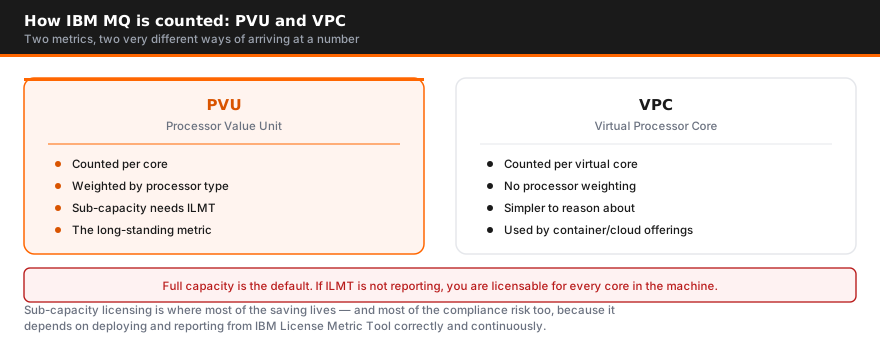
Not exactly — the two sit alongside each other rather than one replacing the other. Virtual Processor Core (VPC) is IBM's metric for containerized and cloud-native deployments, priced per allocated virtual core rather than by processor-family rating. It's the metric that shows up for MQ running on Kubernetes or as a managed cloud offering, where the traditional idea of a "physical processor" doesn't map cleanly onto the deployment.
IBM MQ is also available as a listed product on AWS Marketplace and through Azure, and IBM offers it as a hosted SaaS option on IBM Cloud — each of those routes has its own pricing structure layered on top of, or instead of, the core PVU/VPC decision, which is worth confirming separately if part of the estate is moving to hybrid cloud. Which metric applies depends on how and where a given queue manager runs, and mixed estates — some queue managers on traditional PVU-licensed hardware, others in containers under VPC terms — are increasingly normal rather than an edge case. Confirm the metric attached to each specific entitlement rather than assuming one covers the whole estate.
Why does IBM MQ's lifecycle add to the licensing cost pressure?
Licensing cost and lifecycle timing are two separate pressures that tend to hit at the same time, which is why they get conflated. A version running past its end-of-support date doesn't cost more to license by itself — but it does remove the option of simply staying put while a licensing review runs its course, since an unsupported version is its own compliance finding regardless of what it costs to keep running.
In practice, licensing reviews and version upgrades often get scoped together: an organization evaluating whether it's over-licensed on PVUs is frequently also looking at whether its queue managers are approaching end of support, because both point at the same renewal or budget cycle. For the specific dates by version and what Extended Support does and doesn't cover, see IBM MQ end of support dates.
What are your options if IBM MQ licensing costs feel disproportionate?
For most organizations, the first pass is internal: confirm sub-capacity tracking is actually in place and current, correct any queue managers licensed at the Advanced rate that don't use Advanced features, and right-size non-production and DR environments that were provisioned generously rather than deliberately. Automating that capacity-tracking and reporting step, rather than running it as a manual quarterly scramble, is usually what keeps sub-capacity terms intact between audits. That alone resolves a meaningful share of what gets labeled a "licensing cost problem" — and none of it causes downtime or an outage, since it's a paperwork and configuration exercise, not a change to how the queue managers actually run.
Where the license cost is still genuinely disproportionate to the workload after that — or where a broader messaging or integration modernization is already underway — some organizations look at moving part or all of a workload to an alternative broker: RabbitMQ, Apache Kafka, or ActiveMQ are the three that come up most often, each open source with a different fit. That's a real option, but it's a separate, larger decision that turns on the workload's actual delivery-guarantee requirements, not on the license line alone. It's covered in full in IBM MQ vs RabbitMQ.
Talk to AceMQ about your IBM MQ licensing position
AceMQ works through IBM MQ licensing reviews — PVU versus VPC entitlement checks, sub-capacity tracking gaps, and edition mismatches — alongside the total cost of ownership picture, including for teams that are separately watching end-of-support dates. Talk to AceMQ, or see IBM MQ services and IBM MQ end of support dates for the lifecycle side of the same decision.
If the comparison you are actually running is IBM MQ against RabbitMQ, the other side of that number is RabbitMQ commercial licensing — per-core pricing, and the 72-core minimum AceMQ can quote below.
Licensing cost is step two of six in the IBM MQ modernization guide; what to do with the number is steps three to five.
FAQ
What is IBM MQ's PVU licensing model?
PVU stands for Processor Value Unit. IBM assigns a PVU rating to each processor core based on the chip vendor and model, and the license requirement is that rating multiplied by the number of eligible cores. It measures capacity available to the software, not messages sent or users connected.
How is the number of required PVUs calculated?
Eligible cores multiplied by the per-core PVU rating from IBM's published table equals the required PVU count. The arithmetic is simple; the work is in determining which cores count under your deployment model and confirming the current rating, since IBM updates the table as processor families change.
What's the difference between full-capacity and sub-capacity licensing?
Full-capacity licensing counts every core the physical or virtual host could give the software access to. Sub-capacity licensing counts only the cores actually allocated to the workload, but it requires approved virtualization technology and continuous, retained capacity tracking to qualify — without that evidence, the license reverts to full-capacity terms.
Does IBM MQ Advanced cost more than standard MQ?
Yes. MQ Advanced carries a higher PVU rate than base MQ because it bundles additional entitlements — built-in encryption, managed file transfer, and telemetry support — on top of core messaging. Licensing every queue manager at the Advanced rate when only a subset needs those features is a common source of overspend.
What is VPC pricing and does it apply to IBM MQ?
Virtual Processor Core (VPC) is IBM's metric for containerized and cloud-native deployments, priced per allocated virtual core rather than per physical processor rating. It sits alongside PVU rather than replacing it — which metric applies depends on how and where the queue manager is deployed, so check the entitlement for your specific deployment model.
What other factors drive IBM MQ licensing costs beyond the PVU count?
Disaster recovery and standby environments, non-production copies used for testing, virtualization sprawl that inflates the eligible core count, and lapsed capacity tracking that forces full-capacity terms all add cost independent of the base PVU rate. The license line is rarely the whole cost picture.
What are the options if IBM MQ licensing costs feel disproportionate?
Right-sizing the deployment and correcting edition mismatches solves it for some organizations. Others weigh migrating some or all workloads to an alternative broker — worth modeling against total cost of ownership rather than the license line alone, and only where the workload's delivery-guarantee requirements are genuinely portable.
Sources

Author
Talk to an engineer
Need a hand with IBM MQ?
Senior engineers who run it in production. Get a quote or a free consultation, no sales pitch.