
On this page
IBM MQ is built for guaranteed, once-only delivery in regulated enterprise environments and carries a license cost to match. RabbitMQ is an open-source message broker with flexible routing, broad protocol support, and no license fee unless you buy commercial support. Both handle point-to-point and publish/subscribe well, and both are fault-tolerant and enterprise-grade. The decision is usually about assurance and existing investment rather than capability. If it already carries your settlement traffic, replacing it is rarely the win a spreadsheet suggests.
Whichever way the comparison lands, both brokers need production cover: AceMQ provides IBM MQ support and RabbitMQ support under one contract.
IBM MQ vs RabbitMQ: Key Differences
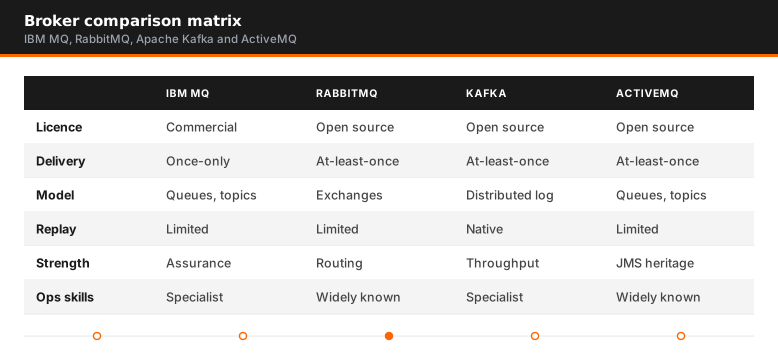
| IBM MQ | RabbitMQ | |
|---|---|---|
| License | Commercial, per-capacity | Open source; support optional |
| Origin | WebSphere MQ, 1993 | Rabbit Technologies, 2007 |
| Delivery | Once-only, assured | At-least-once, confirms available |
| Messaging protocols | Native MQI, JMS, AMQP 1.0, MQTT | 0-9-1 and 1.0, MQTT, STOMP |
| Routing | Queues and topics | Exchanges, bindings, topic patterns |
| Strength | Assurance and auditability | Flexible routing, scalability, use cases across microservices |
| Operations | Specialist skills, mature tooling | Simpler model, wide familiarity |
The real IBM MQ vs RabbitMQ divide is philosophical. It was designed so a message cannot be lost, with transactional semantics and two-phase commit integration that regulated industries were built around. RabbitMQ was designed for flexible messaging patterns — its exchange and binding model does message routing the alternative handles in application code.
Is it still widely used?
Yes, and it is worth being honest about why. Banks, insurers, airlines and payment networks run enormous estates, often decades old, frequently on mainframe. Not legacy in the pejorative sense — load-bearing infrastructure with a real track record.
What has changed is that new development rarely starts there. Teams building microservices reach for an open-source option, so most enterprises now run something modern alongside IBM MQ rather than instead of it.
Where Kafka and ActiveMQ fit
Kafka vs the two? For an event streaming pipeline handling large volumes, Apache Kafka wins comfortably. For assured delivery with once-only guarantees, less so — Apache Kafka is a distributed log optimized for high throughput and replay, not a queueing system with those guarantees. Teams that swap one for the other on throughput numbers alone usually rebuild the guarantees in application code.
Is Amazon MQ the same as RabbitMQ? No — it is a managed service that runs ActiveMQ or RabbitMQ for you. Same software; what you buy is someone else operating it. That option carries deeper JMS heritage for Java estates. How it compares with CloudAMQP and with RabbitMQ run in your own account is covered in managed RabbitMQ services compared.
IBM MQ vs RabbitMQ: Which Should You Choose?
Stay on IBM MQ when you have delivery guarantees written into compliance documentation, mainframe integration, or an estate large enough that migration risk outweighs license cost.
Choose the open-source route when you are building new services, need flexible routing across various messaging patterns, want protocol breadth, or the license cost is genuinely disproportionate to the workload.
Choose Kafka when the pattern is real-time data streaming with replay across many independent consumers in distributed systems, rather than queued work.
What is IBM MQ used for?
IBM MQ carries transactions that cannot be lost. Payment settlement, insurance claims, airline
reservations, order capture, core banking — workloads where a dropped message is a financial or
regulatory event rather than a retry. It has been doing this since 1993 under the WebSphere MQ
name, which is why so many of these estates predate the teams now running them.
The typical deployment is not a greenfield choice. It is infrastructure that was correct when it
was installed, still works, and now sits underneath applications nobody wants to touch.
Does IBM MQ support AMQP, MQTT and JMS?
Yes to all three, and this surprises people who assume it only speaks its own protocol.
- JMS — first-class. IBM MQ is the reference implementation many Java estates were built on.
- AMQP 1.0 — supported, which is what makes bridging to RabbitMQ practical.
- MQTT — supported via IBM MQ Telemetry for device and IoT traffic.
- Native MQI — the original API, still the deepest integration and still common in COBOL and
mainframe code paths.
RabbitMQ covers AMQP 0-9-1 and 1.0, MQTT and STOMP. The overlap on AMQP 1.0 and MQTT is what
makes a phased migration tractable rather than a rewrite.
Does IBM MQ need Java?
Not for the queue manager itself, which is native code. Java is required for the JMS client and
for parts of the tooling, but a queue manager runs without a JVM. This matters when sizing hosts
and when hardening a build — it is a common misconception that the broker is a Java application.
Is IBM MQ free?
No. It is commercial software licensed per capacity, and that license cost is usually what starts
the migration conversation in the first place. IBM offers a free developer edition for
non-production use, which is genuinely useful for testing a bridge before committing to one.
RabbitMQ is open source under the Mozilla Public License. You pay nothing to run it; you pay only
if you want commercial support behind it.
Is IBM MQ obsolete?
No, and treating it as obsolete is how migrations go wrong. It is actively developed, and the
delivery guarantees it provides are still difficult to reproduce elsewhere.
What is true is that new development rarely starts there. Teams building microservices reach for
an open-source broker, so most enterprises now run something modern alongside IBM MQ rather than
instead of it. "Legacy" in this context means load-bearing, not abandoned.
Version support is a real consideration though. IBM publishes end-of-support dates per release,
and running past one puts you in the same position as any unsupported platform: no fixes, and an
audit finding waiting to happen. Check your version against IBM's support lifecycle before
deciding the platform is the problem — sometimes the problem is just the release.
How does IBM MQ clustering work?
Queue manager clusters share definitions and workload-balance messages across instances of the
same queue. It is a different model from RabbitMQ clustering: IBM MQ clusters distribute
messages across queue managers, whereas a RabbitMQ cluster presents one logical broker with
queues replicated across nodes.
The practical consequence during a migration is that you cannot map one to the other directly.
Availability, ordering and failover behave differently enough that a lift-and-shift of the
topology will not do what the diagram suggests.
The commercial side is often the deciding factor — see what IBM MQ licensing actually costs and, if you are moving, the IBM MQ to RabbitMQ migration path.
On cost, the two license very differently — see what IBM MQ licensing costs and, for the other side, RabbitMQ commercial licensing.
When Should You Actually Replace IBM MQ, and How Do You Plan It?
Deciding to move off IBM MQ is usually not a single dramatic event — it's a phase that follows a period of successful modernization elsewhere in the stack. A real client engagement illustrates this pattern directly: after a successful first-phase project — a RabbitMQ deployment covering dead-letter queue management, retry configuration, and broker alarm monitoring — the client's own team began actively planning Phase 2: researching IBM MQ replacement options, targeting internal discovery discussions roughly a month after Phase 1 closed out.
This sequencing is worth calling out explicitly, because it reflects a sound way to approach an IBM MQ transition: validate the alternative broker on a lower-risk workload first, then use that operational confidence to justify replacing IBM MQ specifically, rather than attempting a direct, big-bang cutover from IBM MQ to a new platform without an intermediate proof point.
What actually triggers an IBM MQ replacement conversation?
In practice, it's rarely a single technical failure. More commonly, it's a combination of:
- Licensing cost pressure, particularly as IBM MQ deployments scale and per-core or per-message-unit costs compound
- Operational modernization elsewhere in the stack creating a natural opportunity to reconsider messaging infrastructure alongside it — exactly the pattern in the case above, where RabbitMQ success on an adjacent workload opened the IBM MQ conversation
- Skills availability — IBM MQ administration is a narrower, more specialized skill set than modern open-source messaging platforms, and organizations increasingly find it harder to hire and retain that expertise relative to RabbitMQ or Kafka skills
- Kubernetes/cloud-native infrastructure migration, where IBM MQ's traditional deployment model is a poorer architectural fit than platforms with mature Kubernetes operators
What should a Phase 1 “prove the alternative” project actually validate before you commit to full IBM MQ replacement?
Based on the real sequencing pattern above, a sound intermediate validation phase covers:
- Operational reliability patterns specific to your workload — dead-letter queue handling, retry/redelivery configuration, and broker-level alerting, since these are exactly the operational fundamentals that need to work correctly on day one of any messaging platform, IBM MQ or otherwise
- Team comfort and skill transfer — does your operations team feel confident running the new platform day-to-day, or is expertise still concentrated in a small group (or an external vendor) in a way that would make full IBM MQ decommissioning risky?
- A workload that's representative but not maximally critical — proving the platform on a real production workload matters, but choosing one where a rough early period is tolerable reduces the risk of the pilot itself becoming a reason to abandon the migration
What does the actual replacement plan look like once you're ready?
- Inventory your IBM MQ estate — queue managers, channels, application dependencies, and any IBM MQ-specific protocol usage (MQI, JMS via IBM MQ client) that needs a migration path
- Map IBM MQ concepts to your target platform's equivalents — queue managers to virtual hosts/clusters, channels to connections, and MQ-specific features (like triggering or clustering) to their nearest equivalent pattern on the new platform
- Plan a phased cutover by application or business unit, not a single simultaneous switch — this mirrors the phased approach in the real case referenced above, where Phase 1 validated the new platform before Phase 2 even began scoping the IBM MQ transition
- Budget for a parallel-run period where both systems are operational, allowing rollback if issues surface post-cutover
- Plan IBM MQ decommissioning as an explicit final step, not an assumption — legacy queue managers often persist far longer than planned because a small number of dependent applications weren't fully migrated, so track migration completion at the application level, not just at the infrastructure level
Running IBM MQ vs RabbitMQ Together During a Migration
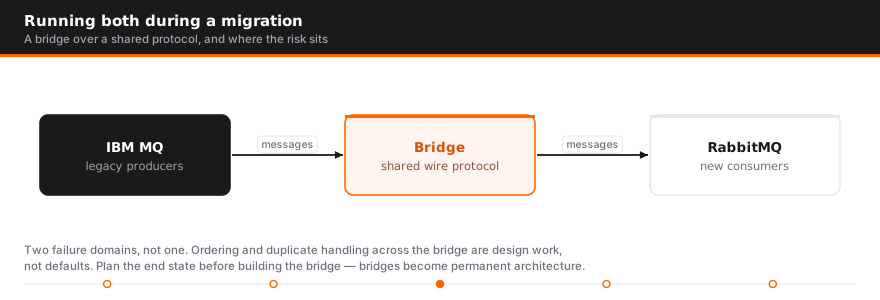
Most modernization is phased, not a cutover. A bridge moves messages between both so new services consume from the open-source side while legacy producers keep writing to the incumbent. Both speak a common wire protocol, which makes the connection tractable.
That interim state is where the risk sits. Running both means two failure domains, and message ordering and duplicate handling across a bridge need designing rather than assuming. Plan the end state before building the bridge — bridges have a way of becoming permanent architecture nobody owns.
Weighing a migration or supporting both? AceMQ works across IBM MQ support and incident response,
RabbitMQ consulting and Kafka support and incident response — including
assessments of whether moving is worth it at all. enterprise MQ support across RabbitMQ, Kafka and IBM MQ, or Talk to an AceMQ engineer.
Teams that have IBM MQ specialists but no RabbitMQ ones often bridge the gap with AceMQ's managed RabbitMQ services: we run the RabbitMQ side during and after the migration while your MQ team keeps its focus.
Which workloads to keep on IBM MQ and which to move is step four of the IBM MQ modernization guide, which sequences the whole decision from end-of-support dates to the migration.
FAQ
What is the main difference in IBM MQ vs RabbitMQ?
One is commercial software built around guaranteed delivery for enterprise environments. The other is open source, built around flexible routing and multiple messaging patterns, free to run with optional paid support.
Can Kafka replace IBM MQ?
For streaming and analytics, often yes. For assured queueing with once-only delivery it is the wrong tool — a distributed log is not a message queue.
Is Amazon MQ the same as RabbitMQ?
No. It is a managed service that runs the broker on your behalf. Same software, different operational model.
How do I connect IBM MQ to RabbitMQ?
Through a bridge over a shared protocol both support. It is the standard approach during a phased migration — but treat ordering and duplicate handling across the bridge as design work, not a default.
Is migration worth it?
Only when license cost is genuinely disproportionate or the platform blocks something you need. Cost alone is a poor reason — license savings are immediate and visible; re-establishing delivery guarantees is neither. If it carries assured traffic with compliance requirements attached, the migration cost usually exceeds the saving.
Sources

Author
Talk to an engineer
Need a hand with IBM MQ?
Senior engineers who run it in production. Get a quote or a free consultation, no sales pitch.


