

On this page
As of 22 October 2026, RabbitMQ 4.4 and 4.3 are the only series in community support, until 31 July 2027 and 31 January 2027. Every 3.x series, including 3.13 (ended 30 September 2024), is past it. A broker past its end-of-life date keeps running, nothing breaks on the day support ends, but every CVE published afterwards is one you carry unpatched.
If you are still on 3.13 or older, this covers the end-of-life date of every series, what the risk actually is, and the three ways out.
Still on 3.x? Extended support and CVE patching. AceMQ backports security fixes to the RabbitMQ build you run, back to 3.8.x, with 24/7 support and a 15-minute response on P1 incidents under contract. See RabbitMQ extended support and CVE patching.
The patch builds behind that come from OSSeva, AceMQ's extended support platform, which also patches other technologies past end of life.
Which RabbitMQ versions are supported
| Series | Status | Notes |
|---|---|---|
| 4.4 | Community support to 31 Jul 2027 | Current series; 4.4.0 released 20 Oct 2026; commercial to 31 Oct 2028 |
| 4.3 | Community support to 31 Jan 2027 | Previous series; latest patch 4.3.6 (16 Sept 2026); commercial to 30 Apr 2028 |
| 4.2 | Commercial support only | Community support ended 31 Jul 2026; commercial to 30 Jun 2030 |
| 4.1 | Commercial support only | Community support ended 31 Jan 2026; commercial to 30 Apr 2027 |
| 4.0 | Past EOL | Community support ended 30 Apr 2025; commercial support ended 30 Sept 2026; removed classic queue mirroring |
| 3.13 | Commercial support only | Last of the 3.x line; community ended 30 Sept 2024, commercial to 31 Dec 2029 |
| 3.12 and older | Past EOL | Community patches ended earlier; 3.9 and 3.8 long gone |
An exact EOL date shifts, so check the official release notes and version support page rather than trusting any third-party table — including this one — for a compliance decision. The pattern is stable even when the dates move: community support follows the current series, and everything behind it is on its own.
When Each Series Reaches RabbitMQ End of Life
RabbitMQ end of support dates by series, as published on the project's release information page (checked 22 October 2026). Commercial dates are indicative; Broadcom's support portal is authoritative.
| Series | End of community support | End of commercial support |
|---|---|---|
| 4.4 | 31 Jul 2027 | 31 Oct 2028 |
| 4.3 | 31 Jan 2027 | 30 Apr 2028 |
| 4.2 | 31 Jul 2026 | 30 Jun 2030 |
| 4.1 | 31 Jan 2026 | 30 Apr 2027 |
| 4.0 | 30 Apr 2025 | 30 Sept 2026 |
| 3.13 | 30 Sept 2024 | 31 Dec 2029 |
| 3.12 | 29 Feb 2024 | 30 Jun 2025 |
| 3.11 | 30 Jun 2023 | 30 Jun 2024 |
| 3.10 | 30 Sept 2022 | 31 Dec 2023 |
| 3.9 and earlier | Ended (3.9 on 31 Jul 2023, 3.6 on 31 May 2018; see the table below) | None |
Read it this way: as of 22 October 2026 only 4.4 and 4.3 still receive community patches. Every 3.x series, and 4.0 through 4.2, is past community support. The release page now lists nothing older than 3.12 and states that unlisted releases are unsupported, so 3.6 to 3.11 have had no fixes from any upstream source for years. The 3.10 and 3.11 rows above are the dates the page showed before it dropped those series. Commercial support runs longest on 3.13 (to the end of 2029) and 4.2 (to mid-2030), which is why those two are the versions to standardize on if you are buying time.
RabbitMQ does not run fixed calendar support windows the way some enterprise software does. A series stops receiving community patches when newer ones supersede it, so your end date depends on release cadence rather than a date you were given at purchase.
Two consequences. You cannot plan an upgrade five years out — you plan continuously. And the move from supported to unsupported is quieter than a vendor EOL announcement, so estates drift into unsupported territory without anyone filing a ticket.
RabbitMQ 3.9 and Older: End of Life Dates for 3.0 to 3.9
The current RabbitMQ release page starts at 3.12, so the dates for older series are easy to lose. These are the dates the project published on its release-series page before those versions were dropped from it, with the final patch release of each series:
| Series | First release | End of life | Final patch |
|---|---|---|---|
| 3.9 | 26 Jul 2021 | 31 Jul 2023 | 3.9.29 |
| 3.8 | 1 Oct 2019 | 31 Jul 2022 (general support ended 31 Jan 2022) | 3.8.35 |
| 3.7 | 28 Nov 2017 | 30 Sept 2020 | 3.7.28 |
| 3.6 | 22 Dec 2015 | 31 May 2018 | 3.6.16 |
| 3.5 | 11 Mar 2015 | 31 Oct 2016 | 3.5.8 |
| 3.4 | 21 Oct 2014 | 31 Oct 2015 | 3.4.4 |
| 3.3 | 2 Apr 2014 | 31 Mar 2015 | 3.3.5 |
| 3.2 | 23 Oct 2013 | 31 Oct 2014 | 3.2.4 |
| 3.1 | 1 May 2013 | 30 Apr 2014 | 3.1.5 |
| 3.0 | 19 Nov 2012 | 30 Nov 2013 | 3.0.4 |
RabbitMQ 3.6 reached end of life on 31 May 2018, after 29 months in service, and 3.6.16 was its last release. Every series in this table has gone without upstream fixes for at least three years. That includes every CVE published against RabbitMQ or Erlang/OTP since then.
Running one of these versions is still common, usually because an application pinned a client library or an Erlang release, so upgrading the broker means changing code no one wants to touch. The practical options are the same as for any 3.x series past end of life: upgrade in steps, move to a new cluster, or put the existing cluster under extended commercial support while the migration is planned. One limit applies at this age: an in-place upgrade from 3.6 cannot jump straight to a current release. It has to step through intermediate series, each with its own Erlang requirement. A new cluster with a blue-green cutover avoids the stepping, at the cost of a migration.
What is the latest RabbitMQ version?
The 4.4 series is current as of 22 October 2026: 4.4.0 was released on 20 October 2026, with 4.3, 4.2, 4.1 and 4.0 behind it in the same major line. The project publishes release notes and ships patches within each series frequently, and the source lives on GitHub, so "on 4.1" is not the same as "patched" — you still need the latest patch release of whichever version you run.
Is RabbitMQ owned by VMware?
Not any more. RabbitMQ began at Rabbit Technologies in 2007, passed through SpringSource, VMware and Pivotal, and now sits with Broadcom following that acquisition. The name is simply Rabbit plus MQ, for message queue — it is not an acronym.
Broadcom maintains the open source project and sells the commercial distribution, Tanzu RabbitMQ. The ownership history matters for one reason: commercial support terms have changed hands repeatedly, and what your organization bought years ago may not resemble what is available in 2026.
Risks of Running Past RabbitMQ End of Life
Nothing fails immediately. The exposure compounds instead:
- Security advisories accumulate. Each CVE affecting your version stays open unless you backport it yourself. This is the one auditors care about.
- Compliance breaks. Regulated environments require a supported version with a documented patch path. "It still works" does not satisfy that.
- Incident response degrades. When something breaks at 2am, community answers start with "upgrade first".
- The upgrade gets more expensive. Every series you fall behind adds a hop, and crossing the major version boundary is where the real work sits.
Erlang version requirements
RabbitMQ runs on the Erlang VM, and each series requires a supported OTP range. When that runtime reaches its end of support, everything on it inherits the exposure — including a deployment whose own release looks current.
Erlang 26 reaching end of support is the forcing function currently pushing teams to RabbitMQ 4.1 and later. We have been distributing Erlang 27 binaries to customers alongside their upgrades for exactly that reason.
The question is never only "is my release supported". It is also "is the runtime underneath it supported". Check both before planning anything.
Breaking changes in the newer major version
The newer line removed things older deployments depend on, which is why this is a project rather than a version bump:
- Classic queue mirroring was removed in 4.0. Mirrored-queue redundancy no longer exists; every affected classic queue has to move to a quorum queue instead. Running RabbitMQ on the older queue type is the single biggest blocker teams hit. See classic and quorum queues for what that involves.
- Quorum queues gained a default delivery limit of 20. Messages that previously redelivered indefinitely now stop, changing behavior for anything relying on infinite retry.
- Erlang requirements moved, so the runtime upgrade usually has to happen first.
- Khepri replaced Mnesia as the metadata store, changing how cluster state is held.
- Client libraries may need updating alongside the broker, and AMQP 1.0 support has matured since the older line.
- Deprecated features were removed outright, not merely flagged.
These are breaking changes, not deprecations. Meeting them during a maintenance window is the common failure mode.
Your Three Options at RabbitMQ End of Life
1. Upgrade to a supported series
The right answer where it is available. Roll through the cluster one node at a time so it keeps serving, and step through patch releases rather than jumping the whole gap — we routinely take customers from 3.13.10 to 3.13.15 to 3.13.18 to clear known vulnerabilities before attempting the move to 4.x.
Rehearse it outside production first, and watch the RabbitMQ management UI through the process — version upgrades are where queue type mismatches surface. Detail in upgrading RabbitMQ 3.x to 4.x without downtime.
2. Take extended commercial support on your current version
Sometimes the upgrade genuinely is not available this quarter — a frozen change window, a certified application, an air-gapped estate, or a vendor who has not qualified the new release.
Extended support beyond 3.12.x exists for that: security patches backported to the version you actually run, so the deployment stays compliant while you plan properly. It converts an open-ended risk into a managed one, which is usually what the auditor wants to see. End of commercial support dates are worth confirming in writing as part of that support lifecycle. Commercial support on an unsupported version is a bridge, not a destination.
3. Re-platform
Occasionally the honest answer is that the fit was wrong and this is a sensible moment to reconsider. Rare — most teams should upgrade — but worth naming rather than pretending.
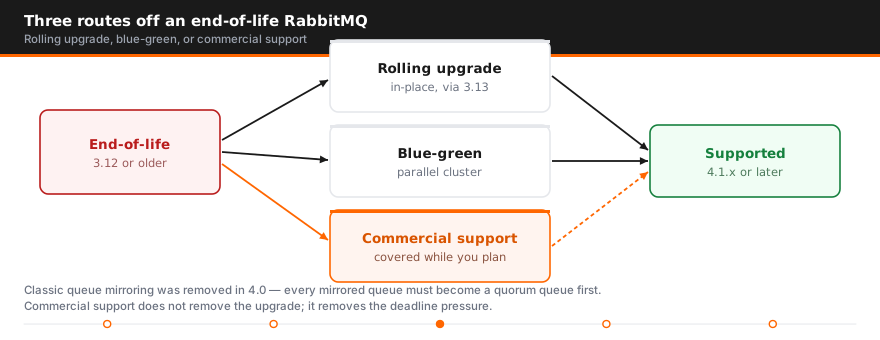
If the answer is to upgrade, the mechanics — rolling versus blue-green, the required hop sequence, the Erlang dependency and the pre-upgrade checklist — are in upgrading RabbitMQ 3.x to 4.x without downtime. If you would rather not run it yourself, our RabbitMQ upgrade service scopes and executes the whole hop sequence inside your change window. If the answer is to stay, extended LTS support is the contract that makes staying defensible.
Which advisories your series is exposed to, and which patched versions exist for it, is set out in the RabbitMQ CVE register.
What not to do
Do not freeze and hope. A stale deployment under critical queues is an unbounded liability.
Do not upgrade blind across the major boundary. Removed features surface during the window, which is the worst time to meet them.
Do not treat it as only a version number. Check Erlang, client libraries, the management plugin, and third-party plugins. A plugin built against an older broker refuses to load and rarely names itself in the error.
Running an end-of-life RabbitMQ and unsure which option applies? AceMQ provides
RabbitMQ support for legacy versions — security patching for out-of-support releases,
upgrade planning for clusters you cannot take offline, 24/7 escalation, and optimization work while you get current.
If the answer is a supported commercial route, open source versus commercial RabbitMQ sets out what each gives you.
FAQ
Which RabbitMQ versions are currently supported?
The 4.x series. RabbitMQ 4.4, released on 20 October 2026, is current, and 4.3 stays in community support until 31 January 2027. The 3.x line including 3.13 has reached end of life. Check the official release information page for exact dates before making a compliance decision.
When did the older series reach end of life?
Community support ended on 30 September 2022 for 3.10, 30 June 2023 for 3.11, 29 February 2024 for 3.12 and 30 September 2024 for 3.13, which was the last 3.x series. In the 4.x line, 4.0 ended on 30 April 2025, 4.1 on 31 January 2026 and 4.2 on 31 July 2026. Only 4.3 and 4.4 are inside community support, until 31 January 2027 and 31 July 2027.
Can a RabbitMQ 3.x version still get security patches after end of life?
Yes. Extended commercial support backports security patches to the series you actually run, including 3.x lines that no longer receive community fixes. It exists precisely for estates that cannot upgrade this quarter — a frozen change window, a certified application, an air-gapped deployment, or a vendor who has not qualified the newer release. It converts an open-ended risk into a managed one, which is normally what an auditor wants to see. Treat it as a bridge while you plan the upgrade, not a permanent destination.
Is it safe to run a version past its EOL date?
Only with a patch path. Either take commercial support that backports security fixes to your version, or upgrade. The risk is an accumulating set of unpatched CVEs rather than an immediate failure.
What is the latest RabbitMQ version?
The 4.4 series is current: 4.4.0 was released on 20 October 2026. Within any series you also need the latest patch release, so running 4.3 without 4.3.6 (16 September 2026) is not the same as being up to date.
Is RabbitMQ owned by VMware?
No. Ownership moved to Broadcom through that acquisition. Broadcom maintains the project and sells Tanzu RabbitMQ commercially.
How old is RabbitMQ?
It first shipped in 2007 from Rabbit Technologies, making it one of the longer-established message queue systems still in active development.
What are the Erlang version requirements?
Each series specifies its own supported OTP range, and they move with the release line. Erlang 26 reaching end of support is currently pushing teams to RabbitMQ 4.1 and later with Erlang 27. Check the compatibility matrix before scheduling an upgrade.
What breaks during major version upgrades?
Classic queue mirroring was removed in 4.0, so mirrored-queue high availability must move to quorum queues. Quorum queues also gained a default delivery limit of 20, changing redelivery behavior. Erlang requirements usually shift as well.
Sources

Author
Talk to an engineer
Need a hand with RabbitMQ?
Senior engineers who run it in production. Get a quote or a free consultation, no sales pitch.
Go deeper on RabbitMQ
- GuideThe RabbitMQ Performance Tuning GuideRead the guide
- GuideThe RabbitMQ Streams GuideRead the guide
- GuideThe RabbitMQ Reliability Guide: Ten Failure Patterns and Their FixesRead the guide
- GuideThe RabbitMQ Disaster Recovery GuideRead the guide
- GuideThe RabbitMQ Clustering and Sizing GuideRead the guide
- GuideThe RabbitMQ on Kubernetes GuideRead the guide
- GuideThe RabbitMQ Migration GuideRead the guide
- GuideThe RabbitMQ Security and Hardening GuideRead the guide
- GuideThe RabbitMQ Monitoring and Alerting GuideRead the guide
- GuideRabbitMQ for AI Agents: Patterns, Setup and PitfallsRead the guide
- GuideCelery and RabbitMQ for LLM Task QueuesRead the guide
- GuideAgent-to-Agent Messaging over AMQP and RabbitMQRead the guide
- ComparisonRabbitMQ vs Amazon SQS ComparedSee the comparison
- ComparisonRabbitMQ vs Redis ComparedSee the comparison
- ComparisonRabbitMQ Providers Compared: Amazon MQ, CloudAMQP, Stackhero, Northflank, Tanzu and AceMQSee the comparison
- ComparisonMessage Broker Support Options ComparedSee the comparison
- ComparisonRabbitMQ vs Kafka vs NATS for AI AgentsSee the comparison
- ComparisonFIPS-Compliant RabbitMQ Options ComparedSee the comparison
- ComparisonCloudAMQP Alternatives for RabbitMQSee the comparison
- ResearchWhat Breaks in Production RabbitMQ: 145 Support Tickets, 2023 to 2026Read the research
- ResearchRabbitMQ in Production 2026: What 22 Assessed Estates Actually RunRead the research
- ResearchThe RabbitMQ CVE Register, 2026 EditionRead the research


