On this page
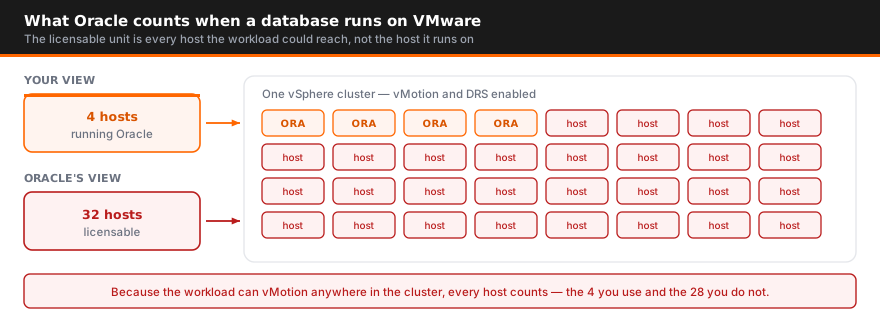
A four-host Oracle workload on a thirty-two-host cluster can attract licensing for thirty-two hosts. That is the trap, and it is entirely about where the database could run rather than where it does run.
This is one of the most expensive misunderstandings in enterprise virtualization, and Broadcom's licensing changes have quietly made the standard remedy cost more. Worth saying plainly at the outset: this is how the positions are commonly argued, not legal advice, and your own agreement is what governs.
The VMware side is a per-core subscription like any other, and a VMware renewal quote gives you that half of the Oracle-on-VMware cost.
Soft Partitioning, and Why It Matters
Oracle divides virtualization into hard partitioning, which it accepts as limiting licensable capacity, and soft partitioning, which it does not. VMware vSphere is classified as soft partitioning.
The consequence is that the licensable unit stops being the virtual machine and becomes the physical hardware. Every processor in every host the workload could run on counts — not the vCPUs you allocated, not the host it happens to be on this afternoon.
vMotion and DRS widen it further. Live migration is the feature that makes 'could run on' expansive: if the workload can move, the destinations count too. Storage vMotion and cross-vCenter migration paths extend the argument further still, which is why organizations that built one large flexible cluster are the most exposed.
The Policy Is Not the Contract
This is the part that gets skipped, and it is the most useful thing on this page.
Oracle's Partitioning Policy is a policy document published alongside its Software Investment Guide. It carries an explicit statement that it is provided for educational purposes and is not part of the license agreement. Your obligations are set by your ordering document and license agreement — not by a PDF that can be revised.
That gap is where most credible defenses live, and it is why the useful first step is having someone read your actual agreement rather than debating the policy. Two organizations with identical VMware architectures can have genuinely different obligations because they signed different paper.
None of which makes the exposure imaginary. An audit is expensive and disruptive even when you are right, and the practical goal is usually to remove the argument rather than win it.
What Works, and What Only Looks Like It Works
- Does not reliably work: host affinity rules, DRS host groups, CPU pinning, resource pools. All are soft controls that an administrator can change, and Oracle's policy does not recognize them as license boundaries. Keep them — they are good operational hygiene and they evidence intent — but do not build a license position on them alone.
- Works, because it is architectural: genuine physical separation. A dedicated Oracle cluster on dedicated hosts, with its own storage, and ideally its own vCenter so no cross-vCenter migration path exists even in principle. The test is simple — can an Oracle workload technically reach unlicensed hardware? If the honest answer needs a paragraph, the separation is not clean.
- Also works: not virtualizing the database at all. Unfashionable, and for some estates still the cheapest answer once the license arithmetic is done properly.
| Control | Oracle's stated view | Why |
|---|---|---|
| Host affinity / DRS host groups | Not accepted | An administrator can change it at any time |
| CPU pinning | Not accepted | Soft control, same reasoning |
| Resource pools | Not accepted | Does not bound the physical hardware |
| Dedicated cluster + dedicated hosts | Accepted in practice | No technical path to unlicensed hardware |
| Separate vCenter | Strongest position | Removes cross-vCenter migration paths entirely |
| Not virtualizing at all | Accepted | Unfashionable; sometimes still cheapest |
What Broadcom Changed
The standard mitigation — a small dedicated Oracle cluster — used to be cheap on the VMware side. It is not any more.
VMware now licenses per physical core, with a minimum of 16 cores per populated socket and a floor of 72 cores per order. So a three-host Oracle cluster with modest processors licenses at the floor whether or not you use it. The Oracle-side saving is unchanged; the VMware-side cost of achieving it went up. The mechanics are in how VMware per-core licensing works.
That changes the calculation rather than the conclusion. Dedicated separation is still usually far cheaper than licensing Oracle across a large cluster — Oracle Database Enterprise Edition per-processor pricing dwarfs VMware's per-core subscription — but the comparison now needs doing with real numbers rather than assumed ones, and the cluster wants sizing deliberately rather than minimally.
Where to Start
- Map the reachable set. For each Oracle workload, list every host it can technically run on today — including via vMotion, DRS and any cross-vCenter path. This is usually wider than the team believes, and it is the number an auditor will build from.
- Read your actual agreement. Ordering document and license agreement, not the policy PDF. If there is a negotiated clause about virtualization, it matters more than anything else on this page.
- Cost the separation properly. Dedicated cluster sized under the current VMware minimums, against the Oracle exposure of the status quo. Both numbers, not one.
AceMQ is a Broadcom partner and sizes and quotes the VMware side of exactly this problem — including dedicated Oracle clusters under the current core minimums. For the Oracle contractual position, use a specialist Oracle licensing advisor or your counsel; we will tell you plainly where our advice stops. Get in touch.
FAQ
Why does Oracle want me to license hosts that are not running Oracle?
Because it treats VMware as soft partitioning, so the licensable unit is every physical host the database could run on — and vMotion makes 'could' expansive.
Is that actually in my contract?
Usually not. The Partitioning Policy states it is educational and not part of the license agreement. Your ordering document and license agreement govern.
Do host affinity rules or CPU pinning solve it?
Not in Oracle's stated view — they are soft controls an administrator can change. Useful operationally, weak as a license boundary.
What actually reduces the exposure?
Physical separation: dedicated hosts, dedicated storage, ideally a separate vCenter, so no technical path reaches unlicensed hardware.
How did Broadcom change this?
It made the fix pricier. A small dedicated cluster now licenses at the 72-core floor with a 16-core-per-socket minimum, so the mitigation costs more than it used to.
What should we do first?
Map every host each Oracle workload can technically reach, and have your actual agreement read. Most find the first wider and the second narrower than assumed.

Author
Go deeper on VMware
- GuideThe VMware Renewal Guide, 2026Read the guide
- ComparisonVMware Renewal Options ComparedSee the comparison
- Comparison1-Year vs 3-Year vs 5-Year VMware SubscriptionsSee the comparison
- ComparisonThird-Party VMware Support vs a Broadcom SubscriptionSee the comparison
- ComparisonVMware Renewal Partner Types ComparedSee the comparison
- ResearchVMware Renewal Pricing in 2026: What 37 Quotes ShowRead the research