On this page
Perpetual VMware licenses are gone. Everything is now term-based, billed per physical core, with a mandatory minimum of 16 cores per CPU, and the old standalone products have been folded into subscription bundles. For most estates that means a materially higher renewal, and the levers that still move the number are core count, term length, and support scope — not the list price.
Once you know what changed, the next step is a VMware renewal quote built on your real core count and tier.
Here is how the Broadcom VMware licensing subscription model works, when the product changes landed, and what to do before your renewal date.
What VMware Licensing Changes Broadcom Actually Made
Three of VMware's changes matter more than the rest:
Perpetual licenses were retired. You no longer own anything. Every entitlement is a term that expires, and lapsing means losing support and access to updates rather than simply staying on an old build.
Pricing moved to physical cores. The unit is no longer the socket or the VM — it is the core, counted across every physical processor in every host running the product.
Standalone SKUs were consolidated. Broadcom folded VMware vSphere Standard, Enterprise Plus, Essentials Plus, and most separately purchased components into a small number of bundles built around VMware Cloud Foundation and vSphere Foundation. Buying just the one VMware product you need is largely no longer an option, and vCenter now arrives inside a suite rather than as a line item.
When the VMware Licensing Changes Took Effect
The acquisition of VMware closed in late 2023, and the move to subscription was announced almost immediately after. Through 2024 the portfolio was consolidated and the partner program was rebuilt. By 2025 most enterprises had hit their first post-acquisition renewal date, and through 2026 the remaining legacy estates are reaching expiry.
The practical implication: this is no longer a change you can wait out. If you are still on prior owned entitlements, your negotiation is happening now rather than at some future point.
How VMware Licensing Changes Affect Per-Core Costs
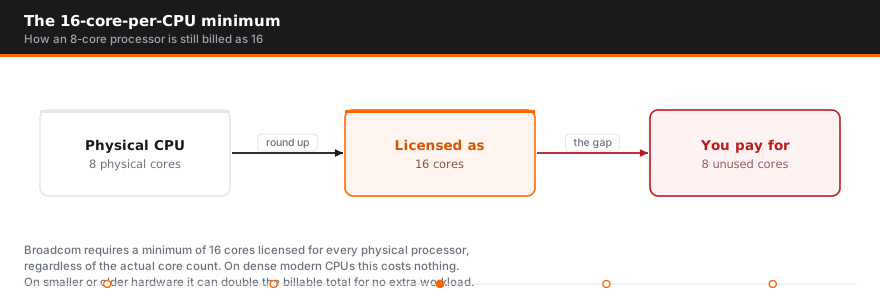
The mechanic that surprises people is the floor. Per Broadcom's own guidance, you must license a minimum of 16 physical cores for each CPU, regardless of how many cores that processor actually has.
A host with two 8-core processors has 16 real cores but licenses as 32. On estates built from lower-core-count hardware, that gap alone inflates licensing costs well beyond what the estate consumes. Some advisory firms also report a broader minimum purchase — a 32-core or 72-core minimum purchase depending on channel and program — though this is not stated in the published core-counting guidance, so confirm it against your own quote rather than assuming it.
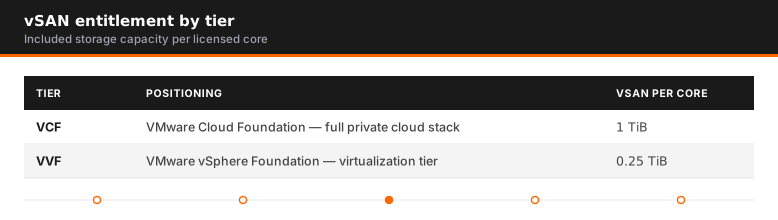
Storage is entitled differently again. Capacity comes bundled per core licensed:
| Bundle | Storage entitlement |
|---|---|
| VCF | 1 TiB per core |
| VVF | 0.25 TiB per core (rounded up) |
Additional capacity is purchasable beyond that entitlement, which is where estates with heavy storage and light compute get caught.
One constraint worth knowing before you commit: you generally cannot move back down from VCF to a legacy SKU. We watched a public-sector customer discover this mid-negotiation — once you are on the top bundle, downgrading is not a lever you still hold.
What the VMware Licensing Changes Cost
Broadcom does not publish a rate card, and any figure you find online is an estimate. What is consistent is direction: tier consolidation moves most customers up, the core minimums put a floor under smaller estates, and the storage entitlement is a capacity cliff rather than a flat allowance. The only way to know what your estate costs is to request a quote.
SMBs are hit hardest. The 16-core floor is regressive — it costs a large data center with dense processors almost nothing and costs a small estate with modest hardware a great deal. If you run a handful of hosts, model your specific configuration rather than applying any published percentage.
Service providers face a separate problem. The partner channel was restructured, tiers were consolidated, and providers who resold VMware at thin margins found the economics rewritten underneath them. If you buy through a provider rather than direct, ask how their own cost base changed before you accept their quote as market rate.
What to Do Before You Sign: VMware Licensing Changes Checklist
The negotiation happens on the inputs, not the rate card.
Audit your real core counts first. Do not accept an assumed number. In one engagement a customer took a planned term from 712 cores down to roughly 630 simply by reconciling the count against a hardware refresh that had already happened. Every core removed is removed for the whole term. Treat this as capacity planning, not procurement paperwork.
Consolidate onto denser hardware. Because the floor is per processor, fewer processors with higher core counts license more efficiently than many small ones. This is a hardware decision with a licensing payoff, so it belongs in the same conversation.
Trade term length for rate. Longer commitments attract better pricing. A three-year commitment is the common baseline, and we have seen five-year terms used specifically to lock a predictable annual figure for budgeting rather than to chase the deepest discount — often the more valuable outcome for a finance team.
Separate support from the subscription and review it on its own merits rather than accepting the bundled figure.
Model your exit credibly. Microsoft Hyper-V, Nutanix, Proxmox, and Red Hat OpenShift Virtualization are real alternative platforms, and Microsoft Azure offers a migration path for VMs leaving the data center entirely. A quantified exit strategy is the only leverage that reliably changes a commercial conversation with an account team. It has to be genuine analysis — a bluff is transparent to anyone who negotiates these for a living.
Check your buying path. Portable subscriptions can be purchased directly from Broadcom in some programs, and contracts routed through the partner channel require deal registration handled correctly in the Broadcom portal. Getting either wrong late in a cycle costs discount, not just time.
Should you migrate or optimize?
For most organizations the honest answer is optimize. Replacing your hypervisor is a multi-year program touching every runbook, backup policy, monitoring integration, and operational habit your team has. Live migration behavior, observability tooling, and automation all have to be rebuilt on the new platform. The subscription increase is painful; a rushed migration across virtualization platforms is usually more expensive once the labor is counted honestly.
That calculus flips for estates that are small, simple, or already substantially in public cloud. If most of your compute is heading to a hybrid cloud footprint anyway, paying full top-tier rates to run a shrinking private cloud remnant makes little sense — one customer we worked with is targeting roughly 75 percent cloud against 25 percent on-premises and sizing the commitment to the destination, not the starting point. Equivalent cloud service options are worth modeling in that scenario.
Two operational notes that rarely appear in pricing discussions but change the picture. Air-gapped and classified environments have a specific activation path — disconnected-mode licensing works, but it needs planning rather than discovery during deployment. And with RAM prices where they are, memory tiering onto NVMe can hold total cost down even as licensing rises, which sometimes matters more than the line item everyone is staring at.
Facing a VMware contract and unsure what you should actually be paying? AceMQ handles VMware licensing and renewal quotes for enterprise customers, including core audits and rough-order-of-magnitude modeling before you commit. Request a renewal quote.
For the dated record of every change since the acquisition, see the VMware licensing timeline. For who can now sell to you, where to buy VMware licenses.
Keep going
What the changes mean at renewal time: the four renewal options compared, and the VMware renewal guide for the sequence.
Related reading
Also worth reading: how vCenter is licensed now.
FAQ
Are perpetual VMware licenses still available?
No. That model was retired and all entitlements now renew on a term. Existing owned licenses continue to function but no longer receive support or updates.
How is VMware licensing calculated now?
Per physical core across all processors running the product, with a mandatory minimum of 16 cores per CPU. A processor with fewer than 16 cores is still billed at 16.
When did the VMware licensing changes take effect?
The subscription move was announced shortly after the acquisition closed in late 2023, with portfolio consolidation running through 2024. Most enterprises hit their first affected contract in 2025 or 2026.
What happened to vSphere Standard and Enterprise Plus?
They were consolidated into the Foundation suites. Most standalone SKUs, including Essentials Plus, are no longer sold separately.
Can I downgrade from VCF to a cheaper bundle at renewal?
Generally no. Moving down from VCF to a legacy SKU is not typically available, which makes the initial choice difficult to reverse. Confirm this before committing.
How much vSAN capacity comes with a subscription?
VCF includes 1 TiB of vSAN capacity per core licensed. VVF includes 0.25 TiB per core, rounded up. Additional capacity is purchased separately.
Will my VMware costs rise?
Almost certainly, since you move from an owned asset to an annual subscription and most estates also move up a tier. How much depends on your core count, hardware density and term, which is why it has to be quoted rather than estimated.
What are the main alternatives to VMware?
Microsoft Hyper-V, Red Hat OpenShift Virtualization, and comparable hypervisors are the platforms most often evaluated, alongside migrating workloads to Microsoft Azure or another cloud environment. Each carries real migration cost, so model it properly before treating it as a threat in negotiation.
What is the fastest way to reduce VMware licensing costs?
Audit actual core counts, then consolidate onto fewer, denser processors. Because the 16-core minimum applies per processor, reducing processor count often saves more than any discount you negotiate.
The Partner Program Cuts: What Happened to Your Renewal
The licensing model was only half of the change. In 2024 Broadcom replaced the open VMware partner program with an invitation-only one, and a large share of the resellers who had sold and renewed VMware for years lost their authorization. For a customer the effect was quiet and abrupt: the company that held your Partner of Record — the partner Broadcom recognises as attached to your account, able to see your renewal data and submit quotes on it — could no longer transact. Renewal notices still arrived. The partner who used to answer them could not.
A VMware subscription can only be renewed through a partner Broadcom currently authorizes, or directly with Broadcom for the accounts it manages itself. So if your partner was cut, the renewal needs a new Partner of Record before it can be quoted. The transfer is a Broadcom process, typically completed in 5–10 business days with Broadcom's approval, and it can run in parallel with the quote. The mistake is waiting until the expiration month to discover the old partner is gone. AceMQ, a Broadcom Expert Advantage Partner, takes over existing renewals and starts the transfer from the contract or entitlement number.
Third-Party VMware Renewal Assistance Is Not Third-Party Support
Two things share the phrase "third-party" and are opposites. Third-party VMware support — Rimini Street, Park Place Technologies and others — is a support contract for a perpetual licence you already own, provided outside Broadcom. It keeps vSphere 7 or 8 running on the version you have, at a lower cost than Broadcom support, and it does not include any new subscription, updates beyond what you are entitled to, or a route to renew. It is a way to stay on a perpetual licence longer, and for some estates that is the right call.
Third-party renewal assistance is an authorized partner transacting your subscription renewal with Broadcom on your behalf: quoting the tiers, sizing the core count against the minimums, setting the term, and holding Partner of Record so the account is serviced. It is the only way to renew a subscription other than going to Broadcom directly. A subscription customer cannot use third-party support in place of a renewal, because the licence itself expires; a perpetual customer can, for as long as the versions they run stay viable.
The decision between them is a version and risk decision, not a price one. Perpetual licences on vSphere 7 or 8 with third-party support run without new features or vendor security updates; a subscription renewal keeps the estate current. Most organisations we quote have already been moved to subscription at their last renewal, which is why the question that reaches us is almost always which partner, not which model.
What Is Negotiable Through an Authorized Partner
List price is an opening figure. Through an authorized partner, four things move. The tier: renewing onto vSphere Foundation instead of VMware Cloud Foundation is the largest saving available and the one Broadcom's own quote will not volunteer. The core count: challenging how the 16-core floor and the 72-core minimum have been applied to your estate, and consolidating hosts before the count is taken. The term: three- and five-year subscriptions are priced below one-year. The support level: Production is included in the subscription; Premier is an add-on and is often on the quote without having been asked for.
What does not move is the model itself — there is no perpetual licence to return to — and the minimums as rules. A partner negotiates inside those rules; nobody negotiates them away. Read our breakdown of what a renewal costs for the arithmetic behind each lever.
Sources

Author
Go deeper on VMware
- GuideThe VMware Renewal Guide, 2026Read the guide
- ComparisonVMware Renewal Options ComparedSee the comparison
- Comparison1-Year vs 3-Year vs 5-Year VMware SubscriptionsSee the comparison
- ComparisonThird-Party VMware Support vs a Broadcom SubscriptionSee the comparison
- ComparisonVMware Renewal Partner Types ComparedSee the comparison
- ResearchVMware Renewal Pricing in 2026: What 37 Quotes ShowRead the research