On this page
VMware licensing cost is calculated per physical core, with a minimum of 16 charged for every processor and a 72-core minimum on any order, sold as a subscription bundle rather than a perpetual license. VMware pricing has no public rate card — every quote is negotiated — so the useful question is not "what is the price" but "which inputs is my price built from, and which of them can I change".
Three inputs decide your VMware licensing cost under Broadcom's pricing: your core count, the bundle tier, and your term length. Only the first two are really under your control.
Want the number for your own estate? Ask for a VMware renewal quote: send your expiration date and core count and AceMQ, a Broadcom partner, returns it within 24 business hours.
VMware license price per core in 2026 (the same table as on our VMware licensing page):
| Edition | Reported list price | AceMQ 2026 quotes, 1-year term | AceMQ 2026 quotes, 3-year term |
|---|---|---|---|
| vSphere Standard | $50 | – | – |
| vSphere Foundation (VVF) | $135 | $117–196 | $100–160 |
| Cloud Foundation (VCF) | $350 | ~$344 | $257–348 |
All figures are per physical core, per year. Broadcom publishes no rate card: list prices are the partner price list as reported by Veeam Community and Rimini Street, checked 20 October 2026. AceMQ quote ranges are from real 2026 quotes; VCF has one 1-year quote. The 16-core minimum per CPU and the 72-core minimum order apply to every row. Confirm vSphere Standard availability for your entity when you ask for a quote. Sources: Veeam Community, vSphere licensing packages and MSRP; Rimini Street, VMware renewal cost estimator.
Price your own estate. Send your core count and expiration date and AceMQ returns a VMware renewal quote within 24 business hours.
Broadcom VMware Price Increase 2026: What Changed and What a License Costs
The VMware price increase since Broadcom's acquisition is mostly a change in what you are required to buy, not one percentage on a rate card. Four changes stack. Perpetual licences became per-core subscriptions, so a renewal now pays for the whole licence every year instead of a support percentage. A catalogue of standalone products was folded into a few bundles, so anything that used to be an à la carte purchase is now a reason to buy a higher tier. Every processor licenses as at least 16 cores. And since April 2025 an order has to reach 72 cores.
How hard the Broadcom VMware price increase lands on you depends on which of those four applies. A dense estate already on the right bundle mostly sees the move from a support line to a subscription. A ten-host estate on 8-core processors sees the minimums as well. If you are comparing a VMware price increase for 2026 against last year's invoice, compare the per-core price for the same tier and the licensed core count, not the invoice totals. Nobody outside Broadcom can say what the next list price will be, which is why a three- or five-year term works as price protection.
The VMware ESXi license cost is not a separate line either. ESXi is the hypervisor inside vSphere Standard, vSphere Foundation and VMware Cloud Foundation, and all three are licensed per core. The table above and the sections that follow show what each costs.
How VMware Licensing Cost Is Calculated
The unit is a physical core. Count them all across your VMware infrastructure, then apply the floor.
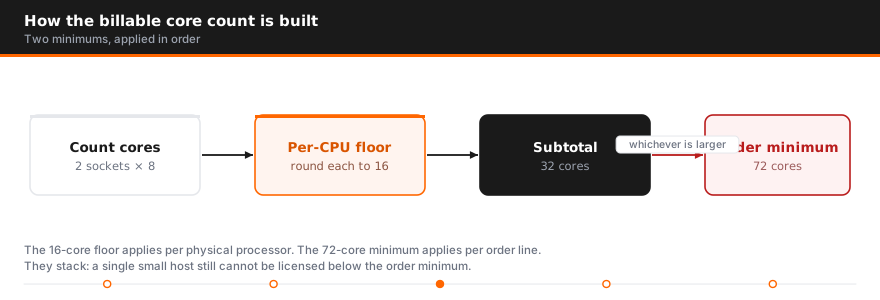
There are two separate minimums, and confusing them is the most common sizing error we see.
The per-CPU floor: 16 cores. You must license a minimum of 16 for each physical processor, regardless of how many it actually has. A two-socket host with 8-core processors has 16 in reality and licenses as 32.
The order minimum: 72 cores. Since April 2025, Broadcom applies a minimum order quantity of 72 per order line. A single small host does not license as 16 — the order still has to reach 72. Small estates pay for capacity they will never deploy.
The two stack. Count first, then round each processor up to 16, then check the total against the order minimum. Whichever is larger is what you buy.
That is where smaller estates lose money. On a dense modern processor the 16-core floor costs nothing. On older or smaller hardware it can double your billable total against no change in workload — and the order minimum then puts a hard floor under the whole transaction.
Which bundle you are quoted
Standalone products largely no longer exist. Broadcom VMware collapsed a catalog of more than 160 products into a handful of subscription offerings — the single largest of the licensing changes to follow Broadcom's acquisition of VMware. Most legacy VMware SKUs did not get a like-for-like replacement; they were absorbed into a tier.
Where the legacy products went:
| Legacy product | Where it lands now |
|---|---|
| vSphere Enterprise Plus | Sold standalone again, and included in both tiers |
| vSphere Standard | Still sold standalone |
| vSphere Essentials Plus Kit | Retired — move up to Standard or above |
| vSphere Essentials Kit, ROBO editions | End of availability, no direct replacement |
| vCenter Server Standard | Included in VVF and VCF |
| vSAN Enterprise | Included as a per-core capacity entitlement; extra capacity is a paid add-on |
| Aria Suite Standard (Aria Operations, Operations for Logs) | Included in VVF and VCF |
| Aria Suite Enterprise (adds Aria Automation, Operations for Networks) | Top tier only |
| NSX networking | Top tier only |
| HCX Enterprise | Top tier only |
| SDDC Manager | Top tier only |
| Tanzu Kubernetes Grid / vSphere Kubernetes Service | Included in VVF and VCF |
| vCloud Suite, vSphere+, vSAN ROBO and Desktop, HCI Kit, Aria Universal | End of availability |
| Horizon and end-user computing | Divested — no longer a VMware product |
The pattern is worth stating plainly: anything that used to be an à la carte purchase is now a reason to buy a higher tier. If you use NSX at all, you are on VCF. That is the mechanism behind most of the increases people describe as price rises — the tier moved, not just the rate.
The two remaining bundles:
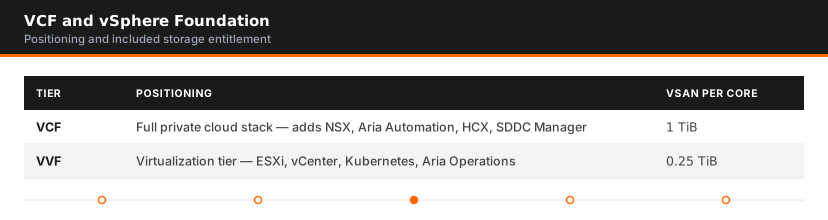
| Bundle | Positioning | vSAN entitlement |
|---|---|---|
| VCF (VMware Cloud Foundation) | Full private cloud stack | 1 TiB per core |
| VVF (VMware vSphere Foundation) | Compute-focused tier | 0.25 TiB per core, rounded up |
VCF carries a materially higher price per core than vSphere Foundation. VMware's storage entitlement is the detail people miss — an estate with heavy storage and light compute can exceed the included capacity and pay again for the difference.
One constraint worth knowing before you sign: you generally cannot move back down from VCF to a legacy SKU. We watched a public-sector customer discover that mid-negotiation. Once you are on the top tier, downgrading is not a lever you still hold.
VMware Licensing Cost in Practice
Broadcom does not publish a rate card, and any licensing calculator you find online is estimating. Resellers quote a server license under agreement, and the figure you are offered depends on your size, your tier, your term, and how the negotiation goes. The only reliable way to find out what your estate costs is to request a quote — anyone quoting you a per-core number off a blog post is guessing.
What we can tell you is which way the inputs push. Tier consolidation moves most customers up. The order minimum puts a floor under small estates. The vSAN entitlement is a capacity cliff rather than a flat allowance. And missing your renewal anniversary carries a late-renewal surcharge, so the calendar is a cost input too.
Small businesses feel this hardest. The core minimums are regressive: they cost a large data center with dense processors almost nothing and cost a small estate with modest hardware a great deal. Enterprises with volume also negotiate; a ten-host shop generally does not.
What VVF and VCF Actually Cost Per Core in 2026
Broadcom does not publish a public rate card, so most figures circulating online are third-party estimates. The numbers below are different: they are the actual per-core prices on licensing proposals AceMQ issued in 2026. Customer names are withheld, the pricing is not.
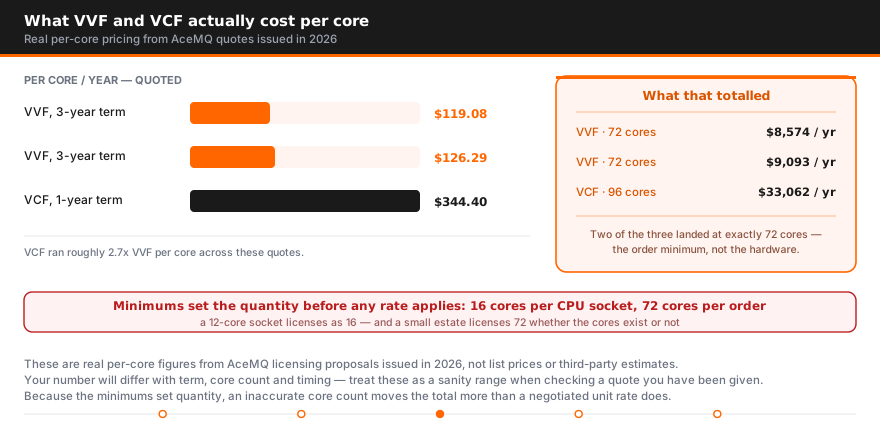
Seven real quotes issued in 2026. The first four were issued on the same day in September, two to one organization and two to another, all for 96 cores:
- VVF, 1-year term, 96 cores — $195.74 per core, $18,791.04 for the term.
- VVF, 3-year term, 96 cores — $160.03 per core, invoiced annually at $15,362.88 ($46,088.64 over the term).
- VVF, 1-year term, 96 cores — $116.93 per core, $11,225.28 for the term.
- VVF, 3-year term, 96 cores — $99.53 per core, invoiced annually at $9,554.88 ($28,664.64 over the term).
- VVF, 3-year term, 72 cores — $119.08 per core, invoiced annually at $8,573.95.
- VVF, 3-year term, 72 cores — $126.29 per core, invoiced annually at $9,092.87.
- VCF, 1-year term, 96 cores — $344.40 per core, $33,062.40 for the term.
Four things are worth pulling out of that.
- The spread is wide. The same 96 cores, quoted on the same day, came in at $116.93 and $195.74 per core on a one-year term, about 67% apart. Per-core pricing now varies a lot from one organization to the next, so treat any single figure, including ours, as one point in a range. More on why VMware quotes vary so much.
- VCF ran roughly 1.8 to 2.9 times VVF per core on a like-for-like one-year term, depending on which VVF quote you compare it with. That ratio, not the discount, is the number that decides your bill. A team negotiating hard on unit rate while accepting VCF by default has optimized the small variable and conceded the large one. If you cannot name the NSX, automation or fleet-lifecycle requirement driving VCF, VVF is the cheaper correct answer — and for most estates it is.
- Two of the seven quotes landed at exactly 72 cores. That is not a coincidence about their hardware; it is the 72-core minimum per order, introduced in April 2025. Below that threshold you license 72 cores regardless. Combined with the 16-core minimum per CPU socket — a 12-core socket licenses as 16 — the minimums frequently set the quantity, and quantity is what the rate multiplies.
- For budgeting, assume roughly $7,200 to $11,500 a year for a 72-core VVF subscription on a three-year term, or $8,400 to $14,100 on a one-year term. Where you land depends on your account and on Broadcom's pricing when you ask, so if you are putting a number in a budget before you have a quote in hand, the upper figure is the one that will not embarrass you later.
On term length: in both same-day pairs above, the three-year rate was 15% to 18% a year below the one-year rate for the same 96 cores. That is not guaranteed, and the terms around it are changing: some buyers are now asked to pay a three-year term up front rather than annually, and multi-year orders are being written without termination-for-convenience clauses. In plenty of deals the per-core rate is not negotiated down for the longer term at all, and what you are buying is price protection: a locked rate for three years while pricing moves underneath you. Given the direction pricing has travelled since the acquisition, either outcome is usually worth having. Ask for both terms on the same core count and compare the annual rate line.
Your own number will differ with term, core count and timing. Use these as a sanity range when you are handed a quote, not as a rate you can order against.
How to Reduce Your VMware Licensing Cost
The negotiation happens on the inputs, not the rate.
Audit the real count first. Do not accept an assumed number from a renewal quote. One customer took a planned term from 712 down to roughly 630 simply by reconciling against a hardware refresh that had already happened. Every one removed is removed for the whole term.
Consolidate onto denser hardware. Because the floor is per processor, fewer of them with higher density license far more efficiently than many small ones. This is a hardware decision with a licensing payoff and belongs in the same conversation.
Trade term length for rate. Longer commitments attract better pricing. We have seen five-year terms used specifically to lock a predictable annual figure for budgeting rather than to chase the deepest discount — often the more valuable outcome for a finance team.
Watch how an increase is offset. When an estate crosses a minimum threshold, the additional volume is sometimes offset by a reduced per core rate. That trade is negotiable, and it is worth asking for explicitly rather than accepting the headline figure.
Right-size the tier. If your VMware workloads do not use the full private cloud stack, being quoted for it is expensive. Match the licensing models on offer to what you actually run — existing VMware customers are frequently quoted a tier above their real usage.
Model your exit credibly. Microsoft Hyper-V, Nutanix and Proxmox are real options, and a quantified alternative is the leverage that reliably changes a commercial conversation. It has to be genuine analysis — a bluff is transparent to anyone who negotiates these for a living.
Facing a renewal and unsure what you should be paying? AceMQ handles
VMware licensing and renewal quotes, including capacity audits and
rough-order-of-magnitude modeling before you commit. Request a renewal quote.
Is there still a free VMware version?
The free ESXi hypervisor has come and gone from availability more than once under different owners, including before and after the acquisition, and its status has not been stable. Treat any free tier as unsuitable for production planning — if a workload matters, license it, and if it does not, question why it is on this platform at all.
Perpetual VMware licenses are no longer sold — subscription-based licensing replaced them. Existing ones keep running but receive no support or updates, which for most organizations makes them a compliance problem rather than a saving.
Should you migrate instead?
For most estates, optimize rather than migrate. Replacing a hypervisor is a multi-year virtualization program touching every runbook, backup policy and monitoring integration you have, and every VM in the estate. The subscription increase is painful; a rushed migration is usually more expensive once the labor is counted honestly.
That calculus flips for estates that are small, simple, or already substantially in public cloud. Paying full top-tier rates to run a shrinking on-premises remnant of VMs makes little sense when the workload is heading to cloud-native infrastructure anyway.
For the full picture of what changed and why, see what Broadcom changed about VMware licensing.
Once you have a number you trust, the next two questions are practical: how to actually request a quote and, if your term ends in the crowded window, why 2027 renewals need starting early.
Is Migrating Cheaper Than Renewing?
Sometimes, and the licence line is the smallest part of the answer. Proxmox VE, Nutanix AHV, Hyper-V and OpenShift Virtualization all run production workloads, so the real comparison is migration engineering time, cutover risk and the automation estate you rebuild against the renewal you can actually negotiate.
We work that comparison in full, with the crossover point and where it sits for different estate sizes, in renew VMware or migrate: the honest cost comparison. If you want the renewal side of the comparison priced properly first, that is a renewal quote.
Keep going
For the per-core figures and minimum arithmetic from 37 real quotes, see what 37 renewal quotes show about pricing. Comparing terms: 1-, 3- and 5-year terms compared.
The reported list price of vSphere Standard, and why the reported update has no price yet, are covered in vSphere Standard return: what is confirmed so far.
FAQ
How much does VMware licensing cost?
There is no public price list. Pricing is per physical core, subject to both minimums above, sold as a subscription bundle, and quoted under agreement. Because the figure depends on your count, tier and term, the only way to get a real number is to request a quote.
How is VMware licensing calculated?
Count every physical core across all processors running the software, apply a floor of 16 per processor, then check the total against the order minimum. You buy whichever number is larger.
What is the 72-core minimum?
A minimum order quantity of 72 cores per order line, applied by Broadcom since April 2025. It is separate from the 16-per-CPU counting rule and sits on top of it. A single small host cannot be licensed on its own — the order still has to reach 72, which forces smaller estates to buy well beyond what they deploy.
Can I still buy a perpetual VMware license?
No. Perpetual licensing was retired and everything renews on a term. Existing perpetual licenses continue to function but no longer receive support or updates.
What is the difference between VCF and vSphere pricing?
VCF is the full private cloud stack and costs materially more. VVF is the compute-focused tier. They also differ on included vSAN capacity — 1 TiB per core versus 0.25 TiB.
Is ESXi still free?
Availability of a free tier has changed repeatedly and is not something to plan production around. Assume you are licensing anything that matters.
How can I reduce my VMware licensing cost?
Audit actual counts, consolidate onto fewer denser processors, right-size the tier, and trade term length for rate. Reducing processor count usually saves more than any discount you negotiate.
Will license renewals cost more than my old perpetual VMware licenses?
Almost certainly, since new VMware terms move you from an owned asset to an annual subscription. vCenter and the rest of the suite now arrive inside a package rather than separately. How much more depends on core count, hardware density, and term.
How much does VMware cost now?
Broadcom publishes no rate card. The partner list prices reported by Veeam Community and Rimini Street, checked on 20 October 2026, are $50 per core per year for vSphere Standard, $135 for vSphere Foundation (VVF) and $350 for VMware Cloud Foundation (VCF). On AceMQ quotes issued in 2026, VVF ran about $117 to $196 per core per year on a one-year term, and VCF about $344. The licensed core count is the physical count after the 16-core-per-CPU floor and the 72-core order minimum.
How much does VMware vSphere cost?
The VMware license cost for vSphere is set per physical core per year. The partner list prices reported by Veeam Community and Rimini Street, checked on 20 October 2026, are $50 per core for vSphere Standard and $135 for vSphere Foundation (VVF). On AceMQ quotes issued in 2026, VVF ran about $117 to $196 per core on a one-year term and $100 to $160 on a three-year term. Every quote applies the 16-core-per-CPU floor and the 72-core order minimum, so a small estate pays for at least 72 cores.
What is the current price of VMware Cloud Foundation?
The reported partner list price is $350 per core per year (checked 20 October 2026, Veeam Community and Rimini Street). AceMQ's one 2026 VCF quote was $344.40 per core on a one-year term, 96 cores. Your price depends on core count, term and account, so the reliable number comes from a quote.
What a VMware Renewal Costs in 2026
A renewal is priced exactly like a new subscription: the same per-core rate for the tier you choose, the same 16-core-per-CPU floor, the same 72-core order minimum, and the same term discounts. There is no separate renewal price list and no loyalty rate. What makes a renewal quote feel different is the starting point. Under the old model, annual Support and Subscription (SnS) ran at roughly a fifth to a quarter of the perpetual licence price. A subscription carries the whole licence every year, so the first renewal quote after a perpetual contract is routinely a multiple of the old SnS line, not a percentage increase on it.
On real AceMQ quotes issued in 2026, vSphere Foundation (VVF) runs about $117 to $196 per core per year on a one-year term and $100 to $160 on a three-year term, and VMware Cloud Foundation (VCF) about $344 on a one-year term. Quotes for the same core count now vary widely: two issued on the same day in September 2026 were about 67% apart per core. Actual renewal pricing is negotiated through an authorized partner and moves with three inputs: the tier you renew onto, the licensed core count after the minimums, and the term.
The renewal-specific costs sit around the licence rather than in it. A lapse in support between contracts means re-instatement rather than renewal. A Partner of Record transfer, if your previous partner lost Broadcom authorization, adds 5–10 business days but no fee. And a renewal that lands inside the last 30 days before expiration leaves no room to compare tiers, which is the most common way a renewal costs more than it should.
VMware Renewal Pricing for Small Businesses
Smaller estates carry the minimums hardest, and a renewal is where that shows up in writing. Take two hosts with two 8-core processors each: 32 physical cores. The 16-core floor per processor licenses that as 64. The 72-core order minimum then rounds the order up to 72. At the list prices in the table above, 72 cores of VVF is $9,720 a year and 72 cores of VCF $25,200 — for an environment that physically has 32 cores. That arithmetic is the reason a small-business renewal quote can be double or triple what the hardware suggests.
Three things reduce it. Renewing onto VVF rather than VCF when NSX, vSAN and the Aria stack are not in use is the largest single lever. A three-year term is the second. Consolidating onto denser processors before the renewal, so the 16-core floor stops costing phantom cores, is the third — and it is only available if the renewal is started early enough to plan hardware around it.
If the estate is genuinely under the 72-core floor and will stay there, the honest comparison is against alternatives, and the renewal quote should show the VMware number beside a migration estimate rather than on its own.
Budgeting a VMware Renewal: The Three Inputs and When to Start
A renewal budget has three inputs and a date. Cores: count every physical core running VMware, round each processor up to 16, and check the total against 72. Tier: VCF if you use the full stack, VVF if you use vSphere and vCenter. Term: one, three or five years, with the longer terms priced below the one-year rate. Multiply the licensed cores by the per-core rate for the tier and term, and you have the list figure to budget against; a partner quote comes in under it.
The date matters as much as the inputs. Start ninety days or more before expiration. That leaves time to get a quote for both tiers, run a Partner of Record transfer if you need one, and decide the term without a support gap. A renewal begun inside thirty days is a renewal at the quoted number. AceMQ returns renewal quotes within 24 business hours from your expiration date and core count, and prints the quote's validity date on it so the budget does not lapse before the decision does.
Sources

Author
Go deeper on VMware
- GuideThe VMware Renewal Guide, 2026Read the guide
- ComparisonVMware Renewal Options ComparedSee the comparison
- Comparison1-Year vs 3-Year vs 5-Year VMware SubscriptionsSee the comparison
- ComparisonThird-Party VMware Support vs a Broadcom SubscriptionSee the comparison
- ComparisonVMware Renewal Partner Types ComparedSee the comparison
- ResearchVMware Renewal Pricing in 2026: What 37 Quotes ShowRead the research