
On this page
A VMware license renewal runs on your subscription's anniversary date, gets repriced against your current core count and tier, and needs a documented core audit and a quote requested 90 to 120 days out to avoid a lapse or an inflated number. The mechanics are procedural, not mysterious — but Broadcom's subscription model removed the slack that perpetual licensing used to give you if you were running a few months behind.
When you reach the quote step, ask AceMQ for a VMware renewal quote with your expiration date and core count.
This covers the renewal process itself: when it actually falls, what makes the number move, what to gather before you ask for a quote, and where estates most often lose money or lose support by mistiming it.
When does my VMware license actually renew?
Your renewal date is the anniversary of your subscription start date — not a fiscal year boundary, not a fixed calendar date, and not necessarily aligned with any other software renewal your organization runs. A VCF or VVF subscription that started on March 14th renews every March 14th for as long as the term runs, whether that's one year, three years, or five.
Multi-year terms don't remove the anniversary — they just push it further out. A three-year subscription still has a hard renewal date at the end of year three; it doesn't quietly extend. If you're not sure when yours falls, it's on your original order confirmation or entitlement record, and it's worth confirming directly rather than assuming it lines up with when you happened to sign the paperwork.
One practical wrinkle: if you're managing several VMware entitlements — vSphere in one business unit, VCF in another, a separate Tanzu order — each one can carry its own anniversary date. Treating VMware renewal as a single annual event is the first assumption that gets estates with more than one contract into trouble.
What triggers repricing at renewal?
Three things move the number, and none of them are optional adjustments you can decline:
Core count changes. If your physical core count grew since your last order — new hosts, denser processors, an acquisition that added hardware — your renewal reflects the current count, not the original one. Broadcom's standard contract language includes annual true-up provisions for exactly this, and it's applied at list price for any overage rather than your negotiated rate. This runs in the direction you'd expect: it also means a documented reduction in core count, from consolidation or decommissioning, should reduce your renewal quote if you can show it.
Tier consolidation. If you were on a legacy standalone SKU — vSphere Enterprise Plus, vSphere Standard, Essentials Plus, a separate NSX license, standalone vSAN — your renewal quote may land you inside VCF or VVF instead, because most of those standalone products no longer exist outside the bundles. That's frequently the actual mechanism behind a renewal number that looks much higher than the prior term: the tier changed, not just the rate. See what Broadcom changed about VMware licensing for how the legacy catalog maps to today's bundles.
Expiring transition credits. Early post-acquisition subscriptions sometimes carried a transition discount or migration credit tied to moving off a perpetual license. Those don't automatically repeat at the next renewal. The anchor for your second-term price is your current subscription rate, not the original perpetual support line you started from.
What doesn't move the number on its own: simply reaching the renewal date. If your core count, tier, and term length are genuinely unchanged, that's the baseline case — and it's exactly the case worth confirming with an audit rather than assuming, since it's the version most often gotten wrong in either direction.
What documentation do you need to gather before renewal?
Four things, ideally assembled before you ask anyone for a number:
- Your current entitlement or contract number. Whoever quotes your renewal needs to pull the exact record, not a general account lookup. Active entitlements, support contract dates, and license keys are visible in the Broadcom support portal if you have login access — worth checking before you request anything, since it's the fastest way to confirm exactly what's expiring and when.
- A reconciled physical core count. Not the figure on your last invoice — an actual count per host, per processor, checked against what's currently racked. Hardware refreshes, decommissions, and consolidations since your last order all move this number, and it's the single input that most determines your renewal price.
- A list of what you actually use. Which bundle components — vCenter, NSX, vSAN, Aria, Tanzu Kubernetes Grid — are in active use versus licensed but idle for your workload. This is what tier-fit conversations are built on, and it's also the moment to decide whether an upgrade to a higher bundle is actually justified by usage rather than assumed.
- Your Partner of Record status. If you're renewing through a reseller, confirm they're still an authorized Broadcom partner. Several smaller VMware resellers lost authorization during Broadcom's partner program restructuring, and a renewal routed through a lapsed partner can stall at the worst possible time.
The core count is worth calling out on its own: an estate that can't quickly produce an accurate, current count is negotiating from a weaker position and carries more audit risk generally, since Broadcom has increased audit activity across its enterprise portfolio. An estate that walks into a renewal conversation with the number already reconciled is negotiating from evidence instead of an assumption.
How far in advance should you start?
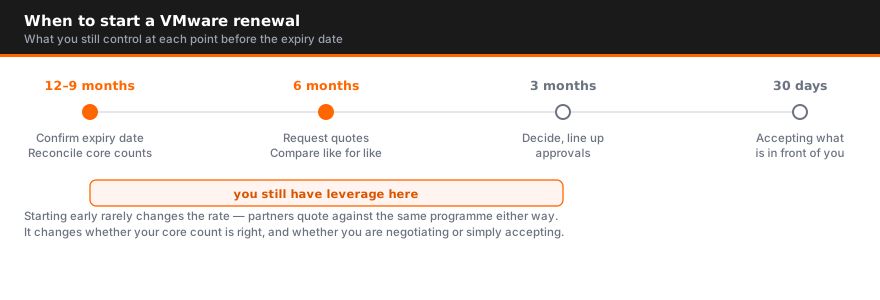
Ninety to 120 days before your renewal date. That window is enough time to run a proper core-count audit, get a quote, negotiate term length or tier fit, and move the purchase through your organization's procurement process without the deadline forcing a decision.
Work backward from the date, not forward from when a renewal notice happens to land in an inbox. A rough sequence: audit your core count and product usage in the first two to three weeks, request a quote and get it in writing, spend the next several weeks on term-length and tier negotiation if the number needs work, then route the finalized quote through procurement — which, for many organizations, is its own multi-week process once legal and budget approval are involved.
If your renewal involves a Partner of Record transfer — moving off an unresponsive or unauthorized reseller — build in the 5 to 10 business days that transfer typically takes, and do it early enough that it isn't competing with the renewal deadline itself.
What happens if you miss the date or let it lapse?
You lose access to support, patches, and updates for the affected products the moment the entitlement lapses — there's no automatic grace window built into the subscription model the way perpetual licensing sometimes allowed in practice. Running production VMware infrastructure without an active support entitlement is a compliance problem for regulated organizations even before it becomes a technical one.
A late renewal is also frequently a more expensive one. Any transition credit or negotiated rate tied to your original term doesn't carry forward automatically, so re-establishing the entitlement after a lapse can mean quoting from a higher baseline than a same-date renewal would have. The calendar itself is a cost input, not just a compliance deadline.
If you've already lapsed, the fix is the same as an on-time renewal, just under time pressure: get the core count reconciled, get a written quote, and move it through procurement as fast as your organization allows. Treating it as urgent rather than routine at that point is the right instinct.
What are the most common mistakes that cause a lapse or overpay?
Waiting for the vendor to reach out first. Renewal notices don't reliably arrive with 90 to 120 days of lead time, and starting the process only after that first notice is what forces a rushed decision instead of a negotiated one.
Accepting the quoted core count without checking it. Renewal quotes are often built from the last order's number, not a fresh count. If hardware changed since then — in either direction — that gap becomes your bill unless you catch it first.
Treating every entitlement as one renewal. Organizations with multiple VMware contracts across business units sometimes track only the largest one, and a smaller entitlement lapses quietly because nobody owned its specific anniversary date.
Not confirming Partner of Record status early. A renewal routed through a reseller who lost Broadcom authorization can stall for weeks at exactly the point you can least afford it.
Assuming the renewal price will match the last one. Between core count true-ups, tier consolidation, and expiring transition credits, a flat renewal is the exception at this point in the Broadcom transition, not the default. Budget for a conversation, not a rubber stamp.
Support Renewal or a New Subscription: Which One Are You Buying?
The question comes up because the old world had two separate things to buy — a perpetual licence you owned, and a support and subscription contract you renewed each year to keep patches and TAC access. Under Broadcom there is one thing. The subscription is the licence and the support, sold together per core for a fixed term, and when the term ends you are not renewing support on something you own, you are subscribing again for the right to keep running it.
That changes what lapsing means. Letting a support contract lapse used to leave you running unsupported but licensed software. Letting a subscription lapse leaves you without a current entitlement to run it at all, which is the point most estates discover through a compliance notice rather than a calendar reminder.
It also changes the shape of the conversation with your partner. There is no separate support SKU to shop around; the term length, the edition and the core count are the whole negotiation. That is why a renewal quote and a new-subscription quote look almost identical — the difference is whether Broadcom already has an entitlement record for your site, which determines the discounting and the paperwork rather than the products.
What to Check Before You Renew
Five things decide what the quote says, and all five are knowable before you ask for one. The licensed core count, which follows the physical cores in the hosts you intend to keep, with a 16-core minimum per CPU and a 72-core minimum on the order. The edition, which should follow what you actually run rather than what was on last year's quote. The term, because one, three and five years are priced differently per year. The expiration date, which sets whether there is a gap to manage. And the entitlement record itself — the site or ERP number Broadcom holds you under, which is what makes a renewal a renewal rather than a fresh order.
The one that most often changes the number is the core count. Estates shrink between renewals; hosts get retired, workloads consolidate, and nobody re-counts. An RVTools export takes minutes and is the single most useful attachment you can send with a quote request, because it settles the count and the edition question in one file.
Two more worth checking while you are in there: whether any of the tiers you are entitled to are genuinely unused — the VCF and VVF comparison covers when moving down is possible — and whether the renewal date lines up with your budget cycle, because the term start can sometimes be set to follow it.
Getting a Renewal Proposal Reviewed
A renewal proposal is worth a second read by someone who quotes them regularly, and that is true whether or not the reviewer ends up being the one who fulfils it. The things a review catches are unglamorous: a core count carried forward from an estate that has since shrunk, an edition that includes entitlements nobody deployed, a one-year term where a three-year would have cost less per year, a late fee that can be discounted, or a quote about to expire before the approval chain finishes.
An authorized partner can also tell you something the proposal itself will not: whether your account is one Broadcom manages directly. The largest accounts are handled by Broadcom's own account teams, and no partner can quote around that. Knowing which side of that line you are on saves weeks of asking the wrong people.
AceMQ reviews renewal proposals as part of a renewal quote request, including proposals originally issued by another partner. Send the quote, the expiration date and the core count; the review comes back with the arithmetic checked and the alternatives priced.
Enterprise License Agreements and Who Owns Them
Enterprise License Agreements sat at the top of the old VMware licensing model: a negotiated, estate-wide agreement with its own term and its own true-up cycle, usually owned by a direct account team rather than a reseller. Under Broadcom, that structure is largely reserved for the accounts Broadcom classifies as strategic, and those are managed directly by Broadcom's account directors.
If your renewal is under an ELA, the practical answer to "who do I contact for pricing" is your Broadcom account director, not a partner — and an authorized partner will tell you that rather than quoting into it. What a partner can still do is quote the products that sit outside the agreement, review the terms you have been offered, and take over the renewals for sites and subsidiaries that are not covered by it.
Everything below that classification — the large majority of commercial, education and public-sector accounts — is quoted through partners, and that is where a renewal quote from an Expert Advantage Partner applies. The cost breakdown explains how those quotes are built.
Keep going
This post covers the process. For the whole renewal in sequence, see the VMware renewal guide; for what the quotes actually cost, what 37 renewal quotes show about pricing.
Get help with your VMware renewal
Working through a VMware renewal and want a second set of eyes on the core count or the quote before you sign? AceMQ handles VMware licensing and renewal quotes, including core-count audits and Partner of Record transfers, with quotes typically delivered within 24 to 48 business hours. Request a renewal quote.
For the mechanics of the request itself — what to send, what a good quote states, and how to compare two fairly — see how to get a VMware renewal quote.
Related reading
Also worth reading: renew VMware or migrate.
Related Resources
FAQ
When does my VMware license actually renew?
On the anniversary of your subscription start date, not a fixed calendar date. A VCF or VVF subscription signed in March renews every March for the length of your term, and Broadcom's system starts flagging the account for renewal outreach roughly 90 to 120 days ahead of that date.
What triggers repricing at a VMware renewal?
Three things: any change in your physical core count since the last order, a move from a legacy SKU into VCF or VVF if you weren't already there, and the loss of any transition-era discount or credit that applied to your original term. None of these are optional adjustments — they apply whether or not your usage actually grew.
What documentation do I need before requesting a renewal quote?
Your current entitlement or contract number, a physical core count per host reconciled against actual hardware (not the number on your last invoice), a list of which VMware products and add-ons you actually use, and your existing Partner of Record information if you're renewing through a reseller.
How far in advance should I start the VMware renewal process?
Start 90 to 120 days before your renewal date. That's enough time to complete a core-count audit, get a quote, negotiate term length, and route the purchase through procurement without hitting the deadline with no fallback option.
What happens if my VMware license lapses?
You lose access to support, patches, and updates for the affected products. In many cases you also lose any negotiated discount or transition credit tied to your original contract, so a late renewal is often quoted at a higher effective rate than an on-time one, on top of the operational risk of running unsupported infrastructure.
What's the most common mistake that causes a VMware renewal to lapse or overpay?
Waiting for Broadcom or a reseller to reach out first. Renewal notices don't always arrive with enough lead time to complete a proper core-count audit, and starting the clock only after that first notice is what pushes people into signing whatever number they're quoted.
Can I negotiate my VMware renewal, or is the price fixed?
It's negotiable on the inputs, not the list rate. Core count accuracy, term length, and tier fit all move the final number, and Broadcom's own contract terms include annual true-up provisions for core count changes — so getting the count right before you're quoted matters more than any discount conversation after the fact.
Do I have to renew through the same partner as last time?
No. If your prior reseller lost Broadcom authorization or isn't responsive, you can transfer your Partner of Record before your renewal date. That transfer typically takes 5 to 10 business days, which is another reason to start the renewal process early rather than at the deadline.
Sources

Author
Go deeper on VMware
- GuideThe VMware Renewal Guide, 2026Read the guide
- ComparisonVMware Renewal Options ComparedSee the comparison
- Comparison1-Year vs 3-Year vs 5-Year VMware SubscriptionsSee the comparison
- ComparisonThird-Party VMware Support vs a Broadcom SubscriptionSee the comparison
- ComparisonVMware Renewal Partner Types ComparedSee the comparison
- ResearchVMware Renewal Pricing in 2026: What 37 Quotes ShowRead the research


