On this page
VVF vs VCF: VMware vSphere Foundation (VVF) has a reported list price of $135 per core per year and VMware Cloud Foundation (VCF) $350, both billed per physical core with a 16-core minimum per CPU and a 72-core minimum order. VCF adds NSX, VCF Automation and SDDC Manager and 1 TiB of vSAN per core; VVF carries 0.25 TiB.
VVF vs VCF price per core, 2026
| Edition | Reported list price | AceMQ 2026 quotes, 1-year term | AceMQ 2026 quotes, 3-year term |
|---|---|---|---|
| vSphere Standard | $50 | – | – |
| vSphere Foundation (VVF) | $135 | $117–196 | $100–160 |
| Cloud Foundation (VCF) | $350 | ~$344 | $257–348 |
All figures are per physical core, per year. Broadcom publishes no rate card: list prices are the partner price list as reported by Veeam Community and Rimini Street, checked 20 October 2026. AceMQ quote ranges are from real 2026 quotes; VCF has one 1-year quote. The 16-core minimum per CPU and the 72-core minimum order apply to every row. Confirm vSphere Standard availability for your entity when you ask for a quote. Sources: Veeam Community, vSphere licensing packages and MSRP; Rimini Street, VMware renewal cost estimator.
On AceMQ's 2026 quotes, VCF ran 1.8 to 2.9 times VVF per core on like-for-like one-year terms, so the edition changes the bill by a multiple while a negotiated discount changes it by a percentage. Two VVF quotes for the same 96 cores, issued the same day, came in at $117 and $196 per core. The multiple comes from 37 renewals AceMQ quoted or reviewed; the VCF licensing explainer shows one VCF quote line by line.
Get VVF and VCF priced on your own cores
Send AceMQ, a Broadcom partner, your expiration date and core count. Both editions come back on the same core count within 24 business hours. Request a VMware renewal quote.
VMware Cloud Foundation is the full private cloud platform — compute, storage, networking and automated lifecycle management in one stack. VMware vSphere Foundation is the virtualization tier: VMware ESXi, vCenter, a smaller vSAN entitlement and basic operations tooling, without NSX. The practical dividing line is networking: if you need NSX, you need VCF.
Is VVF still available? Yes — it is one of the surviving offerings in the simplified portfolio, not a discontinued product. For a great many virtualized workloads it remains the right answer.
What Changed in 2026: vSphere 9 Is Not Sold On Its Own
The most important update to this decision: there is no standalone vSphere 9. vSphere 9 ships only inside VMware vSphere Foundation 9 or VMware Cloud Foundation 9. If you are running vSphere Standard or vSphere Enterprise Plus today, those product lines stop at 8 Update 3 — vSphere Standard went end of sale on 31 July 2025, and both lines carry an end-of-life date in October 2027.
That turns what used to be an optional upgrade into a scheduled decision. Every estate still on Standard or Enterprise Plus has to land on VVF or VCF before that EOL date, and the renewal quote in front of you is where that choice gets made — often without anyone framing it as a choice at all.
Three other changes matter when you compare the tiers today:
- Core minimums are enforced at quote time. Licensing is per physical core with a 16-core minimum per CPU socket, and since April 2025 a 72-core minimum per order. Small estates pay for cores they do not have — size the order before you accept a quote, not after.
- VVF is not guaranteed to be available everywhere. In December 2025 Broadcom withdrew vSphere Foundation from several EMEA countries, leaving VCF as the path in those markets. If your entity or a subsidiary sits in an affected country, the tier comparison below may already be settled for you.
- The Aria branding is gone. What this page calls Aria Operations is now VCF Operations, and the automation layer is VCF Automation. The capability split between the tiers is broadly unchanged; the names on your quote are not.
The rest of this comparison still holds — the dividing line is still networking, storage entitlement and lifecycle management. What changed is that staying put is no longer one of the options.
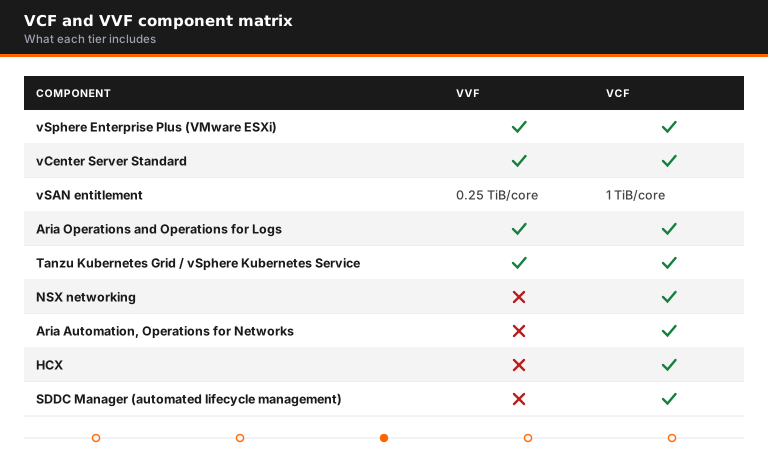
VMware Cloud Foundation vs vSphere Foundation: What Each Tier Includes
| Component | VVF | VCF |
|---|---|---|
| vSphere Enterprise Plus (VMware ESXi) | ✅ | ✅ |
| vCenter Server Standard | ✅ | ✅ |
| vSAN entitlement | 0.25 TiB per core | 1 TiB per core |
| Aria Operations and Operations for Logs | ✅ | ✅ |
| Tanzu Kubernetes Grid / vSphere Kubernetes Service | ✅ | ✅ |
| NSX networking | ❌ | ✅ |
| Aria Automation, Aria Operations for Networks | ❌ | ✅ |
| HCX | ❌ | ✅ |
| SDDC Manager (automated lifecycle management) | ❌ | ✅ |
Two things about VMware Cloud Foundation vs vSphere Foundation surprise people side by side.
The lower tier includes Kubernetes. Tanzu Kubernetes Grid ships in it, so you do not need the full-stack platform to run containers on vSphere. A lot of teams adopt VCF for a capability they already have.
VCF is not simply "the lower tier with a bigger allowance". The additions are whole product categories — software-defined networking, automation, disaster recovery and migration tooling, and a manager that patches the stack as a unit. If you would not deploy them, you are paying for a private cloud experience to run a virtualization platform.
VMware Cloud Foundation vs vSphere Foundation: The Real Dividing Line
Work through it in this order.
Do you need NSX? Micro-segmentation, distributed firewalling, overlay networking, or security features that a compliance requirement names explicitly. If yes, stop — you need VCF. This is the single most common reason to move up, and there is no partial option.
How much vSAN capacity do you need per core? The 0.25 TiB per core is a real allowance, not a token one, but it is a quarter of what the top tier grants. A data center with heavy storage and modest processing demand can exhaust it and pay again for add-on capacity. Storage economics catch people out more often than the CPU sizing does — do the arithmetic against your actual footprint first.
Do you want the stack patched as a unit? SDDC Manager is the quiet differentiator. Automated lifecycle management across ESXi, vCenter and NSX is genuinely valuable at scale, and genuinely constraining if you like upgrading components independently on your own deployment schedule.
How many hosts is this? Full-stack automation and self-service IaaS earn their keep across dozens of hosts, where scalability and agility are the point. On a handful of hosts the overhead can exceed the operational saving.
Are you extending into public cloud? HCX matters for hybrid cloud migration and for disaster recovery between sites. If your workloads stay on-premises and always will, it is capability you are unlikely to use.
Can you start with VVF and move up later?
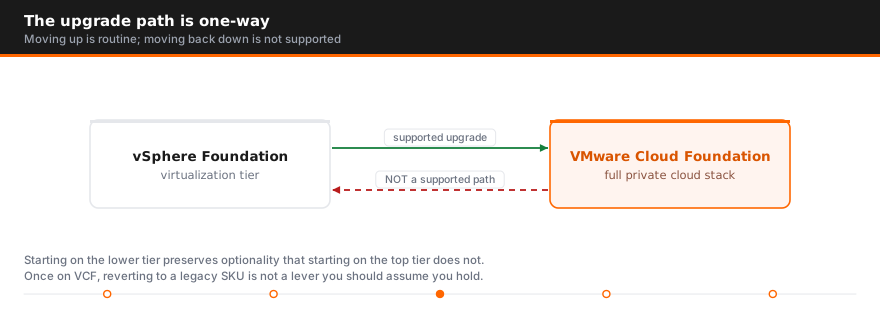
Yes — the transition to VCF is a normal commercial motion, and starting lower while you evaluate is a reasonable strategy. The upgrade from VMware vSphere Foundation to the full platform is a supported path.
Going back down is the problem. Once you are on the top tier, reverting to a legacy SKU is not a supported path. We watched a public-sector customer discover exactly that mid-negotiation: they wanted to step back to what they had been running, and the option simply was not on the table. Whatever leverage they had disappeared with it.
So the asymmetry is the thing to plan around. Moving up later is easy. Moving back down is not a lever you should assume you hold. When the decision is close, starting lower preserves optionality that starting high does not.
The mixed-estate problem
Most renewals we see are not a clean single-product decision. A typical estate carries several legacy SKUs bought at different times — vSphere Essentials Plus on some hosts, vSphere Enterprise Plus on others, perhaps a block of perpetual licenses nobody has touched in years.
One customer came to us with 144 cores split across two different legacy products, a contract expiring in under a month, and no clear picture of where each SKU landed in the new portfolio. That is not unusual and it is not incompetence — Broadcom collapsed a catalog of more than 160 products, and the mapping was never obvious from the outside.
Two practical consequences. First, audit what you actually hold before anyone quotes you, because a renewal quote built on an assumed inventory is a quote for the wrong thing. Second, a mixed estate does not have to renew as a single tier — splitting workloads across both is legitimate where the requirements genuinely differ. A workload running plain virtualization and a workload needing integration and management across cloud environments are different problems, and the VMs can be licensed accordingly.
Facing a renewal and unsure which tier fits? AceMQ handles VMware licensing and renewal quotes, including estate audits that establish what you hold before anyone prices anything. Request a renewal quote.
How the licensing models compare
VMware's new licensing model applies the same mechanics to both: per physical core, subscription only, with a minimum of 16 cores charged per CPU and a 72-core minimum on any order. Perpetual licenses are no longer sold, and since 2025 the order minimum has been the binding constraint for smaller estates.
They differ on rate, not method. VCF costs materially more per core, which is why right-sizing usually saves more than negotiating the rate does. For how the core counting and minimums actually work, see how VMware licensing cost is calculated — and for the wider portfolio changes, what Broadcom changed about VMware licensing.
Because pricing is quoted under agreement rather than published, the only way to settle VMware Cloud Foundation vs vSphere Foundation against your own estate is to have both quoted.
If the honest answer might be neither, the renew-versus-migrate cost comparison prices both paths.
For the full VCF picture — components, cores and cost — see VCF licensing explained.
Keep going
The tier decision sits before the term decision: 1-, 3- and 5-year terms compared. What the tier change saved on real quotes is in what 37 renewal quotes show about pricing.
Related reading
Also worth reading: what replaced vSphere Essentials Plus.
FAQ
What is the difference between VMware Cloud Foundation vs vSphere Foundation?
VCF is the full private cloud platform — it adds NSX Enterprise networking, Aria Automation, HCX and lifecycle management, plus a four-times-larger storage entitlement. The lower tier covers VMware ESXi, vCenter, Kubernetes and basic operations tooling. If you need software-defined networking, you need VCF.
Is vSphere Foundation still available?
Yes. It survived the portfolio simplification and is actively sold.
What is VMware Cloud Foundation?
An integrated, unified platform that bundles processing, storage, networking and management into a single subscription, with SDDC Manager handling upgrades across the whole stack rather than component by component. It is designed to simplify and streamline operations at data center scale and to deliver a self-service, cloud-like consumption model on-prem.
Does vSphere Foundation include Tanzu?
Yes. Tanzu Kubernetes Grid, now delivered as vSphere Kubernetes Service, is included. You do not need the full-stack platform to run Kubernetes on vSphere.
Is VCF subscription-only?
Yes. Both tiers are subscription. Perpetual licensing was retired across the portfolio — existing perpetual licenses keep running but receive no support or updates.
Can I upgrade from vSphere Foundation to VCF later?
Yes, and it is a routine motion. Plan carefully in the other direction: moving back down to a legacy SKU once you are on the top tier is not a supported path.
How much vSAN capacity do I get?
0.25 TiB per core on the lower tier and 1 TiB per core on the top tier. Entitlements aggregate across licenses of the same tier, and additional capacity can be bought as an add-on.
Is VCF replacing vSphere?
No. VMware vSphere is the hypervisor and remains the foundation of both. VCF is a platform built around it, not a replacement for it.
Moving From VCF to VVF at Renewal
Renewal is the one moment the tier is genuinely open. A subscription is bought for a term, and at the end of it you choose what to subscribe to next — the same edition, or a different one. Organisations that took VMware Cloud Foundation at their first Broadcom renewal because it was the bundle on the quote, and have since found that NSX, vSAN and the Aria management tools are not in use, can renew onto vSphere Foundation instead. On 2026 one-year quotes that is the difference between roughly $344 and $117 to $196 per core per year, on the same licensed core count.
Two things do not change with the tier. The 16-core-per-CPU floor and the 72-core order minimum apply to VVF exactly as they do to VCF, so the licensed core count on the new quote matches the old one. And the term choices are the same: one, three or five years, with the longer terms priced lower per year. What changes is the per-core rate and what you are entitled to run.
The practical check before asking for a VVF quote is an entitlement inventory: which VCF components are deployed, which are licensed but idle, and whether anything on the roadmap needs them within the new term. An authorized partner can quote both editions on the same core count so the comparison is side by side. AceMQ does this as part of a VMware renewal quote; the arithmetic behind the per-core figures is in our breakdown of VMware licensing cost.
vSphere Foundation vs vSphere Standard
vSphere Standard is the hypervisor tier: ESXi plus vCenter Server Standard for management, and that is the extent of it. vSphere Foundation is the same hypervisor with the operations layer added — the Aria management tooling for capacity, logs and performance, and a vSAN capacity entitlement measured per licensed core. Both are sold per core, both carry the 16-core-per-CPU floor, and both are subscriptions rather than perpetual licences.
The question that decides it is whether anything above the hypervisor is in use. An estate that runs virtual machines and nothing else — no software-defined storage, no centralised log analysis, no capacity modelling — is paying for entitlements it never touches at the Foundation tier. An estate that already runs vSAN, or that has been told to consolidate storage onto the hosts, needs Foundation or above, because Standard carries no vSAN capacity at all.
Standard also stops earlier on scale and automation. It is the right answer for a small estate with a stable footprint, and the wrong answer for one that is about to grow into shared storage or a second site.
Broadcom executives said in September 2026 that an updated vSphere Standard is coming, with no price or date published as of 22 October 2026. The status line by line: vSphere Standard return.
Does vSphere Foundation Include vSAN?
Yes, but as a capacity entitlement rather than an unlimited licence. As packaged today, vSphere Foundation carries a quarter of a tebibyte of vSAN capacity per licensed core, and VMware Cloud Foundation carries a full tebibyte per core. The entitlement pools across the licensed cores, so a 72-core VVF subscription arrives with roughly 18 TiB of vSAN capacity to distribute as the cluster needs it.
Two things follow. Estates that need more capacity than the entitlement covers buy vSAN add-on capacity on top of the tier rather than moving up a tier, which is usually the cheaper of the two paths. And an estate with no vSAN deployment at all is holding an entitlement it is not consuming, which is worth naming out loud at renewal — it is one of the few places where a lower tier genuinely costs nothing in capability.
What vCenter Gives You at Each Tier
vCenter Server Standard is included at every tier from vSphere Standard upward, so the management plane itself is not the difference between the editions. What changes around it is the tooling: Foundation adds Aria Operations and Aria Operations for Logs, and Cloud Foundation adds the broader Aria Suite along with NSX networking and the larger vSAN entitlement.
The practical limits people run into are not licensing limits but configuration maximums — hosts per cluster, VMs per host, linked vCenter instances — and those come from the vSphere release, not the subscription tier. An estate hitting those numbers needs a design conversation, not a bigger SKU. Where the tier does bite is features that assume the extra products: NSX-backed segmentation, stretched clusters, and the automation that expects the full Aria set.
Sources

Author
Go deeper on VMware
- GuideThe VMware Renewal Guide, 2026Read the guide
- ComparisonVMware Renewal Options ComparedSee the comparison
- Comparison1-Year vs 3-Year vs 5-Year VMware SubscriptionsSee the comparison
- ComparisonThird-Party VMware Support vs a Broadcom SubscriptionSee the comparison
- ComparisonVMware Renewal Partner Types ComparedSee the comparison
- ResearchVMware Renewal Pricing in 2026: What 37 Quotes ShowRead the research