

Most Redis incidents are not really Redis failing. They are Redis behaving exactly as configured, in a way the application did not expect.
That single fact is why scope matters more than response time on a Redis support contract — and scope is the clause almost nobody reads until the incident that falls outside it.
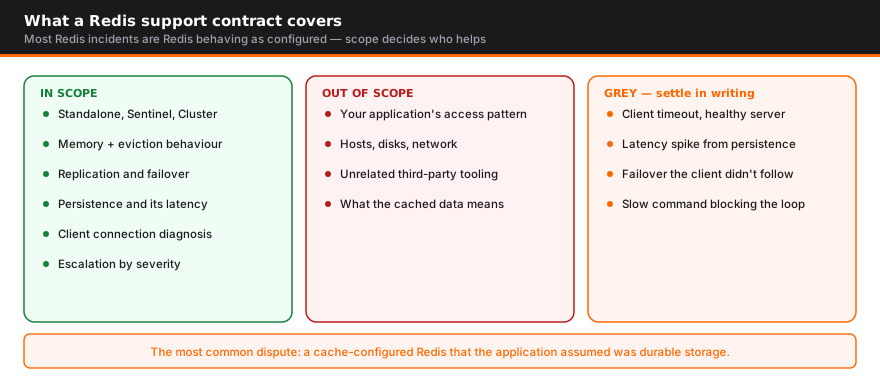
What Is Normally In
- Availability and topology. Standalone with a replica, Sentinel, and Cluster mode each fail differently — slot management and cross-slot constraints in Cluster, quorum sizing and client awareness in Sentinel, resync behavior in standalone. All three should be named in scope, not assumed. See high availability patterns.
- Memory and eviction. Behavior at maxmemory, policy selection, and diagnosing growth that does not track key count — covered in memory growth without more keys.
- Replication and failover. Lag under write load, and failovers that complete cleanly rather than half-way.
- Persistence. Configuration and its latency cost, which is a frequent and non-obvious source of spikes.
- Client connection diagnosis, and escalation with a response commitment by severity — see Redis incident response.
| Topology | How it fails | What support should cover |
|---|---|---|
| Standalone + replica | Resync behavior under load | Replication lag, promotion, data-loss window |
| Sentinel | Quorum sizing, client-side awareness | Split-brain writes to a demoted primary |
| Cluster | Slot management, cross-slot commands | Resharding, slot migration, client routing |
The Cache-or-Datastore Boundary
This deserves its own section because it causes more disputes than any other single thing.
Redis can be a cache or a datastore. The configuration differs — eviction policy, persistence, replication guarantees — and the two are not interchangeable. An enormous share of production incidents are an application treating a cache-configured Redis as durable storage and discovering, during an eviction event, that it never was.
Support will identify that in minutes. It will not decide for you whether the answer is to change the eviction policy, add persistence, resize memory, or fix the application's assumption — that is an architecture decision with cost implications on your side. A good provider raises it during onboarding rather than during the outage, which is the practical argument for a contract that includes design review.
The Grey Areas
- Client timeouts against a healthy server. Usually connection pool exhaustion or a blocking command, not the server at all. See client timeouts with a healthy server. A provider who declines this because "Redis is fine" is technically right and practically useless.
- Latency spikes from persistence. Redis is doing what it was told to do; the impact is real.
- A failover the client library did not follow. The server failed over correctly. The application kept writing to a demoted node.
- Slow commands on the hot path. A single expensive operation blocking the event loop is an application pattern with a Redis symptom.
In all four the useful provider helps first and attributes afterwards. Establish which kind you have before you need to know.
Settle It Before You Sign
Take three Redis incidents you have genuinely had and ask a prospective provider, for each: covered, excluded, or grey? The answers are useful; the way they answer is more useful still.
Then confirm two things explicitly. Whether design and architecture review is included or billable — if it is billable, nobody will ask, and you lose the cheapest prevention available. And whether the provider will hold your topology and runbooks in advance, because a provider onboarding during an incident is starting from zero at the worst possible moment.
AceMQ supports production Redis and Valkey estates with design review and advisory access inside the contract. See how we support Redis, or get in touch.
This is step one of six in the Redis and Valkey support buyer's guide; for where a managed cache, Redis Cloud or self-managed Redis fits, see managed Redis options compared, and for Redis run by AceMQ on your own infrastructure, managed Redis services.
FAQ
What does a Redis support contract normally include?
Availability across all three topologies, memory and eviction, replication and failover, persistence, client diagnosis, upgrades, and escalation with a response commitment.
What is usually excluded?
Your application's use of Redis, the infrastructure beneath it, and unrelated third-party tooling.
What is the most commonly misunderstood boundary?
Cache versus datastore. Most incidents are an application assuming durability from a configuration that never guaranteed it.
Where do contracts get argued?
Client timeouts against a healthy server, persistence-driven latency spikes, failovers the client library did not follow, and slow commands blocking the event loop.
Should design and architecture review be included?
Yes — it is the highest-value part. Eviction, replication and persistence decided correctly up front prevent most break-fix incidents.
How do I test a provider's real scope?
Describe three incidents you have actually had and ask whether each would be covered. How they answer predicts how they behave at 3am.
Go deeper on Redis
- GuideThe Redis Reliability GuideRead the guide
- GuideBuying Redis and Valkey Support: The GuideRead the guide
- GuideThe Redis Backup and Disaster Recovery GuideRead the guide
- GuideRedis for AI: Vector Search, Agent Memory and MCP in ProductionRead the guide
- ComparisonRedis vs Kafka ComparedSee the comparison
- ComparisonValkey vs Redis: Where the Fork and Redis 8.0 DivergeSee the comparison
- ComparisonManaged Redis Options ComparedSee the comparison
- ResearchThe Redis and Valkey CVE Register, 2026 EditionRead the research


