On this page
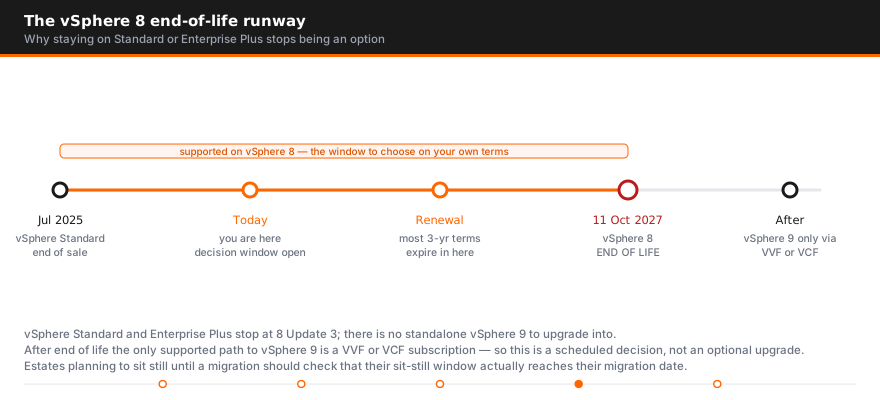
vSphere 8 reaches end of life on 11 October 2027, and there is no vSphere 9 Standard or Enterprise Plus to upgrade into. That second half is the part most teams have not absorbed. vSphere 9 exists only inside VMware vSphere Foundation or VMware Cloud Foundation — so for anyone running Standard or Enterprise Plus, this is not a version upgrade. It is a move to a different product, on a fixed deadline.
That turns what looks like a routine end-of-support notice into a scheduled platform decision, and it lands for a lot of estates at the same time as a renewal. This piece covers what the deadline actually forces, the three real paths, and the arithmetic worth doing before anyone quotes you.
If your renewal is already coming up, ask for a VMware renewal quote now and use the rest of this page to check it.
vSphere 8 EOL Options: Which Fits
vSphere 8 end of support lands on one date, 11 October 2027: the ESXi 8 end of life and the vCenter 8 end of life fall on the same day. The table has five rows: the three paths covered below, plus two holding positions, third-party support and running unsupported, that buy time without settling the decision. Which one fits depends on when your renewal falls and what you run today.
| Path | What it means | Best when | Watch for |
|---|---|---|---|
| Renew | Renew on the edition you hold, or onto VVF or VCF. vSphere 8 support still ends on 11 October 2027. | Your renewal falls before October 2027 and you want a shorter term while the updated vSphere Standard terms become public. | The 16-core and 72-core minimums. Term length is the main discount lever. |
| Upgrade to VCF 9 | Move to VMware Cloud Foundation 9, where vSphere 9 ships alongside NSX, VCF Automation and SDDC Manager. | You need software-defined networking, self-service provisioning or fleet lifecycle management. | VCF ran roughly 1.8 to 2.9 times VVF per core on our like-for-like one-year quotes. If you would not deploy those components, VVF is the cheaper upgrade. |
| Third-party support | Keep perpetual vSphere 8 licences running with an independent support firm after Broadcom support ends: break-fix help and the provider's own mitigations, but no vendor patches. | The estate is frozen, small or being retired, has no compliance regime, and the clock on it is short. | No Broadcom patches, no hosts beyond what the perpetual key covers, no move to a current release. Treat it as a bridge with an end date. Third-party VMware support vs a Broadcom subscription sets the two side by side. |
| Run unsupported | Keep vSphere 8 running past 11 October 2027 with no support contract at all. | Rarely. At most an isolated host that is already scheduled to be switched off. | No patches or security fixes on the hypervisor, no supported upgrade path later, and the audit exposure of any unsupported estate. Perpetual holders with lapsed support may not be entitled to the build they run. |
| Move | Run the workloads on another platform. This is a separate migration project. | A move is already planned and funded. | Hardware, retraining and a period of running two platforms. Teams that decide late often renew once to buy time. The renew vs migrate cost comparison works the numbers for both. |
Not sure which row you are in? Send your core count and expiration date and we will price VVF and VCF side by side. The VCF vs VVF comparison covers the tier choice in detail.
Price your own estate. Send your core count and expiration date and AceMQ returns a VMware renewal quote within 24 business hours.
What Actually Changed
Three facts, in the order they matter.
- vSphere Standard went end of sale on 31 July 2025. You cannot buy it new. Existing agreements run their term.
- Standard and Enterprise Plus stop at 8 Update 3. There is no version 9 of either edition. Whatever build you are on is close to the last one those product lines will ever receive.
- vSphere 9 is not a standalone SKU. It ships inside VVF or VCF. This is the structural change — Broadcom collapsed a large catalog into a small number of bundles, and the standalone hypervisor edition is not one of them.
Put together: the thing you are running has a terminal version and a terminal date, and the successor is a bundle rather than an edition. If you have been treating this as "we will upgrade when we get to it", the upgrade you are picturing does not exist.
The Three Paths
Every estate on Standard or Enterprise Plus lands on one of these. They are not equally priced and they are not equally disruptive.
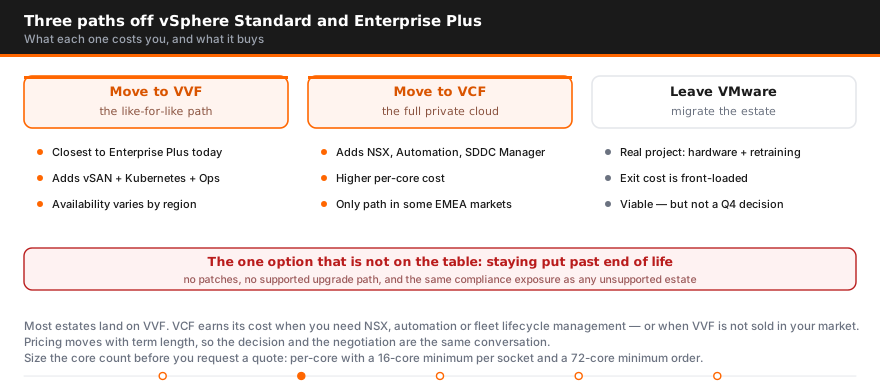
- VVF is the like-for-like path. It carries the Enterprise Plus hypervisor capability and adds vSAN entitlement, vSphere Kubernetes Service and operations tooling. For most estates this is the answer, and the transition is a commercial motion rather than an architectural one.
- VCF is the step up. NSX networking, VCF Automation, VCF Operations for Networks and SDDC Manager fleet lifecycle management. It costs more per core and it earns that when you genuinely need software-defined networking, self-service provisioning, or to patch a large fleet as a unit. If you would not deploy those, you are buying a private cloud platform to run a virtualization workload. We work through that decision in detail in VCF vs VVF: which tier do you need.
- Leaving VMware is real but front-loaded. Some estates should. It involves hardware, retraining, a cutover plan and a period of running two platforms — which is why it is a program decision, not a way to dodge a renewal quarter. Teams that decide this late usually end up renewing once anyway to buy the runway.
One regional caveat that removes the choice for some organizations: Broadcom withdrew VVF from several EMEA countries in December 2025. If your entity or a subsidiary sits in an affected market, VCF may be the only supported path, and that is worth confirming before you build a business case around VVF pricing.
The Arithmetic That Moves the Quote
Licensing is per physical core, and two minimums decide more of the total than the list price does.
- 16-core minimum per CPU socket. A socket with 12 physical cores licenses as 16. On a fleet of smaller hosts that gap compounds quickly.
- 72-core minimum per order, introduced in April 2025. Small estates pay for 72 cores whether or not they have them. If you are running a handful of hosts, this single rule may be the largest line on your quote.
Two practical consequences. First, host consolidation changes the number — fewer, denser hosts can license better than many small ones, and that is worth modeling before you commit to a hardware refresh. Second, term length is the main discount lever: multi-year commitments price materially better than one-year, so the tier decision and the term negotiation are the same conversation.
Count your cores before you request a quote. A renewal quote built on an assumed inventory is a quote for the wrong thing, and it is much harder to unwind after it has been issued.
What Doing Nothing Actually Costs
Running past end of life is always technically possible. What it means in this environment is worth stating plainly.
No patches and no security fixes, on a hypervisor that sits underneath everything else you run. No supported upgrade path when you eventually move, which usually makes the later migration harder rather than easier. And the same compliance posture as any unsupported estate — which matters more than it used to, because Broadcom has been actively pursuing perpetual license holders whose support has lapsed.
If that describes you — perpetual licenses, expired SnS — there is a further constraint worth understanding before you plan around "we will just stay where we are": you may not be entitled to the build you are currently running. We covered that in can Broadcom disable your perpetual VMware license. The short version is that there is no remote kill switch, but the constraint is version rather than time, and post-expiration patches are exactly what the cease-and-desist letters target.
How to Plan It
Four steps, and the first two are the ones that get skipped.
- Inventory what you actually hold. Which editions, on which hosts, with which expiry dates. Mixed estates carrying two or three legacy SKUs are the norm, not the exception, and the mapping into the new portfolio is rarely obvious from the outside.
- Count physical cores per socket and model both minimums against your real footprint. Do this before you talk to anyone about price.
- Decide the tier on requirements, not on the quote. Do you need NSX? Do you need automated fleet lifecycle management? If the honest answer is no, VVF is the answer and you should not be talked upward.
- Start early enough to have leverage. A large share of the base converted to three-year terms in 2024 and 2025, so renewals and this deadline cluster in the same window. Quote turnaround and attention both get scarcer as that builds.
Every dated 2027 event, including what else Broadcom ends on 11 October 2027, is in VMware licensing in 2027.
If you want the inventory checked and VVF and VCF priced side by side against your actual core counts, talk to AceMQ — we are a Broadcom partner and we run this analysis weekly. We will also tell you when VVF is plainly the right answer, because for most estates it is.
This date does not land alone. A large share of three-year subscriptions expire alongside it — what else lands in the 2027 window.
Update, September 2026: Broadcom Says a New vSphere Standard Is Coming
On 2 September 2026, at VMware Explore, Paul Turner (chief product officer, VMware Cloud Foundation Division) and Ram Velaga (president, Broadcom Infrastructure Software Group) told The Register that VMware will release an updated vSphere Standard. Turner said the sales incentives that steered customers toward VCF have been "corrected". Velaga described Standard as suited to estates of around 128 cores; Turner mentioned memory tiering as a possible feature. More detail, including how it will be sold, was expected at Explore on Tour in Frankfurt on 13 and 14 October 2026.
What this does not change, yet: vSphere 8 remains the last shipped Standard release and still ends general support on 11 October 2027. No new Standard SKU is orderable, no price has been published, and nothing has been said about Enterprise Plus. The three paths above still apply until an orderable product exists.
What it does change is the renewal conversation. Nothing is orderable, so a renewal due now cannot include the update. Ask for VVF on your current cores, and if Standard is the right size for your estate, a one-year term keeps that option open. We will update this post when the product is announced.
Update, 22 October 2026: mid-October has passed. Frankfurt was the expected venue, and we found no published price, release date or sales channel afterwards. What is confirmed, what executives said and what is still missing is set out in vSphere Standard return: what is confirmed so far.
FAQ
When does vSphere 8 reach end of life?
11 October 2027. That is where the vSphere 8 line ends, and it is where vSphere Standard and Enterprise Plus stop — neither edition was produced for vSphere 9. After that date there are no patches, security fixes or technical support for those versions.
Is there a vSphere 9 Standard or Enterprise Plus?
No. vSphere 9 is not sold standalone at all — it ships only inside VVF or VCF. vSphere Standard went end of sale on 31 July 2025 and neither edition has a version 9, so the path from Enterprise Plus is to a different product rather than a newer edition.
What are my options before October 2027?
Move to VVF (the closest like-for-like successor), move to VCF (adds NSX, automation and SDDC Manager at higher per-core cost), or migrate off VMware entirely — a real project rather than a way to avoid the decision.
Do I have to move to VCF, or is VVF enough?
VVF is enough for most estates. VCF earns its cost when you need NSX, self-service automation, or fleet-wide lifecycle management. One caveat: Broadcom withdrew VVF in several EMEA countries in December 2025, so in those markets VCF may be the only path.
How is the new licensing counted?
Per physical core, with a 16-core minimum per CPU socket and a 72-core minimum per order introduced in April 2025. Both bite hardest on small estates and low-core hosts. Model the arithmetic before requesting a quote.
Can I just stay on vSphere 8 after end of life?
You can keep running it, with no patches, no security fixes, no supported upgrade path, and the compliance posture of any unsupported estate. If you hold perpetual licenses with lapsed support, there are further constraints on which builds you are entitled to run at all.
When should we start the decision?
Earlier than feels necessary. The core-count and tier analysis takes time you will not have in a renewal window, and a large share of the base converted to three-year terms in 2024–25 — so renewals and this deadline cluster together, making quote turnaround and partner attention scarcer as the wave builds.
Do ESXi 8 and vCenter 8 reach end of life on the same date?
Yes. ESXi 8 and vCenter Server 8 are components of vSphere 8 and follow its lifecycle: end of general support on 11 October 2027. There is no standalone ESXi 9 or vCenter 9 to move to on a vSphere licence, so the same three paths above apply whether the estate is tracked as vSphere, ESXi or vCenter.
Does VMware 8 EOL mean all support stops in October 2027?
VMware 8 is the usual shorthand for vSphere 8, and its end of general support is 11 October 2027. Broadcom's published list of End of Technical Guidance dates gives 11 October 2029 for ESXi 8.0, vCenter Server 8.0 and vSAN 8.0, but Broadcom no longer sells Technical Guidance and honours it only on valid VMware contracts, not Broadcom ones. For most estates, 11 October 2027 is the date to plan the renewal around.

Author
Go deeper on VMware
- GuideThe VMware Renewal Guide, 2026Read the guide
- ComparisonVMware Renewal Options ComparedSee the comparison
- Comparison1-Year vs 3-Year vs 5-Year VMware SubscriptionsSee the comparison
- ComparisonThird-Party VMware Support vs a Broadcom SubscriptionSee the comparison
- ComparisonVMware Renewal Partner Types ComparedSee the comparison
- ResearchVMware Renewal Pricing in 2026: What 37 Quotes ShowRead the research