

The first thing to know is what does not exist: there is no first-party managed RabbitMQ on Azure.
Azure's native messaging is Service Bus, Event Hubs and Storage Queues. None of them is RabbitMQ, and none speaks AMQP 0-9-1 the way RabbitMQ clients expect. So "RabbitMQ on Azure" always means one of four things, and the choice between them is really a choice about where you want the operational boundary to sit.
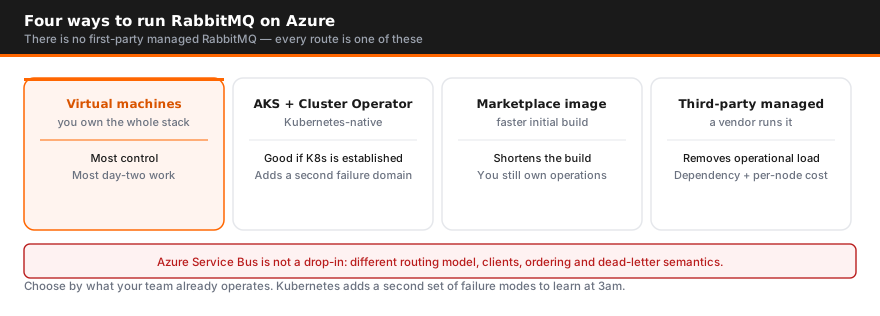
The Four Routes
- 1. Virtual machines. You provision the VMs, install Erlang and RabbitMQ, and own clustering, storage, patching and upgrades. The most control and the most work. For most teams without an established Kubernetes practice, this is the lowest-risk option — the failure modes are RabbitMQ's own, and they are well understood.
- 2. AKS with the RabbitMQ Cluster Operator. The operator handles a great deal: cluster formation, rolling updates, and reconciliation. It suits organizations that already run Kubernetes properly. It also means a RabbitMQ incident can now be a Kubernetes incident — storage class behavior, pod eviction, node draining — so it adds a second system whose failure modes you must also know.
- 3. Marketplace images. These shorten the initial build. They do not change who owns day-two operations, which is still you. Check what version the image ships and how patching is expected to work before treating it as a managed product.
- 4. Third-party managed providers. Several vendors run RabbitMQ for you inside Azure. This genuinely removes operational load, at the cost of a dependency and per-node pricing that grows with the cluster. Read what the SLA actually commits to — response, not resolution.
VMs or AKS: Choose by Team, Not by Fashion
The decision that matters is not technical elegance, it is who will be awake at 3am.
- AKS is right when you already operate Kubernetes in production, your team understands StatefulSets, persistent volume claims and pod disruption budgets, and you have somewhere to run the cluster operator properly. Then RabbitMQ becomes another workload on a platform you already know.
- VMs are right when Kubernetes would be new, or when it exists but nobody is truly on the hook for it. Quorum queues are unforgiving about storage disappearing underneath them, and a Kubernetes-mediated storage problem is much harder to diagnose at speed than a disk on a VM.
We have written the wider comparison in RabbitMQ on EKS vs AKS vs GKE, and the deployment mechanics in RabbitMQ on Kubernetes and OpenShift.
What Actually Breaks on Azure
- Storage latency. The single most common cause of unexplained RabbitMQ trouble on any cloud. Quorum queues commit writes to disk on a majority of members, so variable disk latency turns into publisher slowdown and, at the extreme, leader elections. Choose storage for consistent latency rather than headline throughput, and measure it before go-live rather than during an incident.
- Availability-zone placement. Three nodes that all landed in one zone give you the cost of a cluster and the resilience of a single machine. Spread members across zones deliberately and verify placement after any scaling operation — this is exactly the kind of thing that quietly regresses.
- Load balancer health probes. Probes pointed at the wrong port, or with timeouts shorter than a node's restart, will eject nodes that are mid-recovery and turn a rolling upgrade into an outage. Probe something that genuinely reflects readiness.
- Network partitions. Cross-zone traffic is not free or infinitely reliable. Decide your partition handling strategy deliberately — the wider treatment is in high availability and cluster sizing.
| What breaks on Azure | Why | What to do |
|---|---|---|
| Storage latency | Quorum queues commit to disk on a majority of members | Choose for consistent latency, and measure before go-live |
| All members in one zone | Cost of a cluster, resilience of one machine | Spread across zones and re-verify after any scaling |
| Health probe timeouts | Probes eject nodes that are mid-restart | Probe readiness, with a timeout longer than a node restart |
| Cross-zone partitions | Inter-zone traffic is neither free nor perfect | Decide partition handling deliberately, not by default |
Service Bus Is Not a Drop-In
It is worth saying plainly, because it gets proposed in most Azure architecture reviews: moving from RabbitMQ to Azure Service Bus is an application rewrite, not a migration.
Different routing model — no exchanges and bindings as RabbitMQ expresses them. Different client libraries. Different ordering, dead-lettering and delivery-count semantics. Every publisher and consumer needs changing and retesting, and anything relying on RabbitMQ-specific routing needs redesigning.
That can still be the right decision. It is not a way to avoid operating a broker this quarter. The semantic comparison is in RabbitMQ vs Azure Service Bus.
If you want RabbitMQ on Azure designed, deployed and supported properly — including the zone layout and storage choices above — see how AceMQ supports RabbitMQ or get in touch.
If what you actually want is RabbitMQ semantics without the operational load, AceMQ's managed RabbitMQ services run the brokers on your Azure subscription or on our hosted platform, so the migration to Service Bus never has to happen.
The four ways to have RabbitMQ run for you — hosted platform, operated in your own subscription, specialist-hosted, or self-run with support — are set side by side in managed RabbitMQ options compared.
FAQ
Does Azure offer a managed RabbitMQ service?
No. Azure's native messaging is Service Bus, Event Hubs and Storage Queues. Running RabbitMQ on Azure means operating it yourself or buying a third-party managed service that deploys into Azure.
What are the actual options?
Virtual machines, AKS with the RabbitMQ Cluster Operator, marketplace images, or a third-party managed provider running it inside Azure.
VMs or AKS?
Choose by what your team already operates. AKS if Kubernetes is genuinely established; VMs otherwise, because Kubernetes adds a second set of failure modes to learn.
What breaks most often on Azure specifically?
Storage latency upsetting quorum queue writes, availability-zone placement leaving all members in one zone, and load balancer health probes that eject recovering nodes.
Should we use Azure Service Bus instead?
Only if the semantics genuinely fit. It is an application rewrite — different routing model, clients, ordering and dead-letter behavior — not a lift-and-shift.
Can AceMQ run it for us?
Yes — design, deployment and 24/7 support for RabbitMQ on Azure, on VMs or AKS, including zone layout, storage selection and upgrade paths.
Go deeper on RabbitMQ
- GuideThe RabbitMQ Performance Tuning GuideRead the guide
- GuideThe RabbitMQ Streams GuideRead the guide
- GuideThe RabbitMQ Reliability Guide: Ten Failure Patterns and Their FixesRead the guide
- GuideThe RabbitMQ Disaster Recovery GuideRead the guide
- GuideThe RabbitMQ Clustering and Sizing GuideRead the guide
- GuideThe RabbitMQ on Kubernetes GuideRead the guide
- GuideThe RabbitMQ Migration GuideRead the guide
- GuideThe RabbitMQ Security and Hardening GuideRead the guide
- GuideThe RabbitMQ Monitoring and Alerting GuideRead the guide
- GuideRabbitMQ for AI Agents: Patterns, Setup and PitfallsRead the guide
- GuideCelery and RabbitMQ for LLM Task QueuesRead the guide
- GuideAgent-to-Agent Messaging over AMQP and RabbitMQRead the guide
- ComparisonRabbitMQ vs Amazon SQS ComparedSee the comparison
- ComparisonRabbitMQ vs Redis ComparedSee the comparison
- ComparisonRabbitMQ Hosting Options ComparedSee the comparison
- ComparisonMessage Broker Support Options ComparedSee the comparison
- ComparisonRabbitMQ vs Kafka vs NATS for AI AgentsSee the comparison
- ComparisonFIPS-Compliant RabbitMQ Options ComparedSee the comparison
- ResearchWhat Breaks in Production RabbitMQ: 145 Support Tickets, 2023 to 2026Read the research
- ResearchRabbitMQ in Production 2026: What 22 Assessed Estates Actually RunRead the research
- ResearchThe RabbitMQ CVE Register, 2026 EditionRead the research


