

On this page
AceMQ offers Valkey support: 24/7 cover under one contract with Redis, with a 15-minute emergency response, for self-managed and on-premises Valkey. The other sources are the cloud platforms that back the project, for their own managed services (AWS ElastiCache and Google Cloud Memorystore both offer Valkey engines), Percona, the Linux Foundation project and its community channels, and the Redis-ecosystem tooling vendors whose products have added Valkey compatibility.
The question is rarely whether Valkey is production-ready. It is who answers when it breaks.
Valkey exists because Redis changed its licensing, and a fork under Linux Foundation governance emerged with backing from major cloud providers. That origin shapes the support landscape: there is no single controlling vendor selling an enterprise tier, because not having one was substantially the point.
That is a difference in shape, not in availability. Support exists — it just comes from a different set of places.
Valkey Support Providers Compared
The short list, split by where Valkey runs. Managed services include support for the service itself. Self-managed Valkey needs a separate support contract.
| Company | What they support | Where it runs |
|---|---|---|
| AWS | Amazon ElastiCache for Valkey and Amazon MemoryDB for Valkey | Managed, on AWS only |
| Google Cloud | Memorystore for Valkey | Managed, on Google Cloud only |
| Oracle | OCI Cache, a managed Valkey and Redis service | Managed, on OCI only |
| Aiven | Aiven for Valkey, across several clouds | Managed, in Aiven's service |
| DigitalOcean | Managed Caching for Valkey | Managed, on DigitalOcean only |
| Percona | 24/7 support for Valkey and Redis | Self-managed and on-premises |
| AceMQ | 24/7 support for Valkey and Redis under one contract, 15-minute emergency SLA | Self-managed, on-premises, and alongside any managed service |
| Valkey project (Linux Foundation) | Releases, issue tracker and community channels | Community only, no response time |
The split matters more than the names. A managed service supports its own platform and the engine version it ships. It does not support your client configuration, your key design or a self-managed replica running somewhere else. If the estate mixes managed and self-managed Valkey, or Valkey and Redis, an independent provider is usually the only single point of contact.
| Severity | First response | Typical issue |
|---|---|---|
| P1 — Emergency | 15 min | Production down, data not flowing, cluster or node failure |
| P2 — Critical | 1 hour | Severe degradation, rising error rates, approaching capacity limits |
| P3 — High | 4 hours | Performance issues, configuration problems, non-critical failures |
| P4 — Standard | Next day | Questions, guidance, best practices, non-urgent improvements |
Where Support Actually Comes From
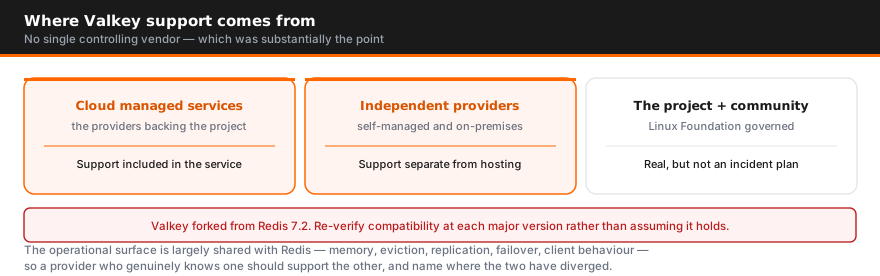
- Managed services. The cloud providers backing the project offer Valkey-compatible managed services, with support included in the service. Straightforward if you are already on that platform and comfortable with a managed model.
- Independent commercial support. Firms that support the Redis-compatible ecosystem generally support both. This is the route for self-managed deployments, on-premises estates, and anyone who wants the support relationship separate from the hosting decision.
- The project and community. Active development, public issue tracking and documentation. Real and useful, and — as with any community channel — not something to build an incident response plan around.
Why One Provider Usually Covers Both
The operational surface is largely shared, and it is the operational surface that generates incidents.
Memory management and eviction behavior. Replication and replica lag. Failover mechanics through sentinel or cluster mode. Persistence and its latency cost. Client connection pooling and timeout behavior. Latency diagnosis and slow command analysis.
Every one of those is essentially the same problem in both systems, which is why a team that genuinely knows one knows most of the other. The divergences are specific and knowable rather than fundamental — see should you migrate from Redis to Valkey for how far apart they actually are.
Before You Put Valkey on Critical Workloads
- Client library compatibility for the exact drivers and versions you use, tested rather than assumed. This is where surprises actually appear.
- Tooling recognition. Monitoring, backup, orchestration and configuration management that expects Redis specifically. Most works; some needs configuring; a little needs replacing.
- A real failover test. Not a documented failover — an executed one, in an environment that resembles production, with clients connected. See high availability patterns.
- An agreed incident path. Who is called, what the response commitment is, and whether they already hold your topology. The detail is in Redis incident response, and it applies identically here.
| Check before production | Why it matters |
|---|---|
| Client driver compatibility | Tested against your exact drivers and versions — this is where surprises appear |
| Tooling recognition | Monitoring, backup and orchestration that expects Redis specifically |
| An executed failover test | Not a documented one — run it with clients connected |
| An agreed incident path | Who is called, the response commitment, and whether they already hold your topology |
The Divergence Question
Valkey forked from Redis 7.2 and both projects have moved since. They are no longer identical, and the gap widens slowly with each release — each has added features and performance work the other does not have.
Core data structures and command behavior remain broadly compatible, which is why migrations in either direction are usually straightforward today. The planning error is assuming that stays true indefinitely without checking. Treat compatibility as something to re-verify at each major version, not as a permanent property.
AceMQ supports Redis and Valkey estates in production — health checks, high-availability design, incident response and ongoing Valkey support with a 15-minute emergency SLA. If you are running or evaluating Valkey for critical workloads, get in touch.
This is step three of six in the Redis and Valkey support buyer's guide; for where a managed cache, Redis Cloud or self-managed Redis fits, see managed Redis options compared, and for Redis run by AceMQ on your own infrastructure, managed Redis services.
FAQ
Is Valkey supported in production?
Yes — through cloud managed services, independent commercial providers and the project community. What it lacks is a single controlling vendor selling an enterprise tier.
How is Valkey support different from Redis support?
Structurally: foundation governance rather than a controlling vendor, so support comes from several independent sources rather than the company that owns the roadmap.
Does an independent provider support both Redis and Valkey?
Generally yes. The operational surface — memory, replication, failover, persistence, client behavior — is largely shared.
What should we check before running Valkey on critical workloads?
Client driver compatibility, tooling recognition, an actually executed failover test, and an agreed incident escalation path.
Are Redis and Valkey diverging?
Gradually. Core compatibility holds today; re-verify at each major version rather than assuming it is permanent.
Can AceMQ support Valkey?
Yes — health checks, high-availability design, incident response and ongoing support for both Redis and Valkey. See AceMQ Valkey support.

Author
Talk to an engineer
Need a hand with Valkey?
Senior engineers who run it in production. Get a quote or a free consultation, no sales pitch.
Go deeper on Redis
- GuideThe Redis Reliability GuideRead the guide
- GuideBuying Redis and Valkey Support: The GuideRead the guide
- GuideThe Redis Backup and Disaster Recovery GuideRead the guide
- GuideRedis for AI: Vector Search, Agent Memory and MCP in ProductionRead the guide
- ComparisonRedis vs Kafka ComparedSee the comparison
- ComparisonValkey vs Redis: Where the Fork and Redis 8.0 DivergeSee the comparison
- ComparisonManaged Redis Options ComparedSee the comparison
- ResearchThe Redis and Valkey CVE Register, 2026 EditionRead the research


