On this page
Redis support pricing in 2026 falls into three models: usage-based managed plans that start with a free tier and scale to hundreds or thousands of dollars per month as memory and throughput grow; annual Redis Enterprise subscriptions from Redis Ltd that are custom-quoted and typically land in the five-to-six-figure range per year at production scale; and third-party support contracts for self-managed or open-source deployments that generally run $1,500–$5,000 per month for business-hours coverage and $3,000–$10,000+ per month for 24/7 coverage with hard response-time guarantees. The four variables that move the price most are the response-time SLA, coverage hours, environment size (nodes, clusters, and GB of dataset), and whether the contract includes hands-on remediation or advisory guidance only.
That is the short answer. The longer answer matters because Redis pricing and Redis support pricing are not the same thing: one is the cost of running the database, the other is the cost of having an expert on the hook when production misbehaves at 2 a.m. This guide breaks down each pricing model, compares the major vendors, and shows what a production support contract should actually include.
What are the Redis support pricing models?
Four pricing structures dominate the market, and most teams end up mixing at least two of them:
- Bundled managed-service support. If you run a fully managed Redis database, baseline support is baked into the plan. Redis Cloud Essentials starts with a small free tier and moves into fixed monthly plans, while Redis Cloud Pro is pay-as-you-go, billed per GB of memory and by throughput in operations per second. The official Redis pricing calculator estimates the infrastructure side of that bill, but premium support options — faster responses, a dedicated technical account manager — are typically an upsell on top of base cloud pricing.
- Enterprise software subscription. Redis Enterprise Software, the self-hosted commercial product from Redis (formerly Redis Labs), is licensed annually and usually sized per shard or node, with support included in the subscription. Quotes are custom, and enterprise discount programs plus committed use discounts kick in at volume.
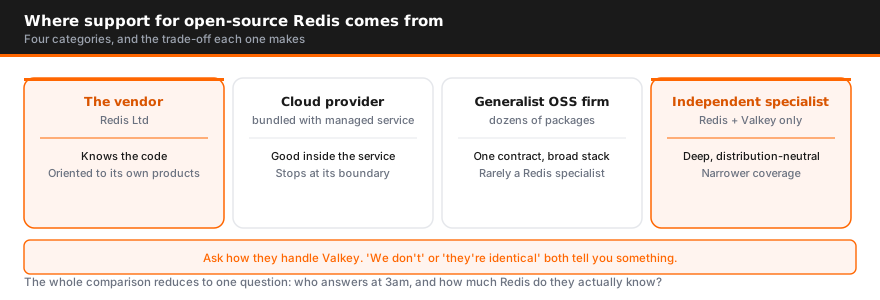
- Third-party support subscription. Independent engineering firms support Redis Open Source and hybrid estates for a flat monthly fee per environment or cluster, with tier pricing driven by coverage hours and SLA rather than by data size. This model tends to deliver the largest cost savings at scale, because the fee does not grow linearly with every extra GB in the cache.
- Retainers and incident packs. Prepaid blocks of consulting hours suit one-off migrations, audits, and performance tuning — but they carry no response-time guarantee, which makes them a poor fit as the only safety net for a revenue-critical workload.
Keep the categories straight when comparing Redis quotes: a managed database bill from a cloud provider pays for compute, memory, and data transfer; a support contract pays for expertise, accountability, and speed. Mixing the two in one spreadsheet is how budgets go sideways.
Redis Enterprise vs third-party support cost
The commercial vendor and the third-party ecosystem price very differently, so the honest comparison is structural rather than a single dollar figure:
| Vendor | Pricing model | What you get |
|---|---|---|
| Redis Ltd (Redis Enterprise) | Annual subscription for Redis Enterprise; usage-based Redis Cloud pricing for the managed service; custom quote at the enterprise tier | Support bundled with the commercial license; premium response tiers and account management cost extra; strongest fit if you standardize on the commercial stack |
| Nextbrick | Third-party support and consulting; tiered plans published, final pricing by quote | Open-source Redis support, health checks, and consulting engagements |
| Ksolves | Hourly rates and monthly retainer models; quote-based | Development-oriented consulting with Redis support among a broader open-source portfolio |
| AWS ElastiCache support tiers | Infrastructure billed per node-hour plus data transfer rates; support sold separately through AWS Support plans priced as a percentage of total AWS spend (Business from $100/month, Enterprise from $15,000/month) | Platform-level help for the managed cache service itself — not application-level debugging of your data model or client code |
| AceMQ | Custom quote sized to your environment and SLA | 24/7 coverage by senior engineers, a 15-minute emergency response SLA, and hands-on remediation for open-source and enterprise deployments alike |
The hyperscaler managed caches deserve a footnote. Memorystore for Redis bundles platform support into Google Cloud's plans, with Memorystore pricing billed per GB-hour by capacity tier on GCP; Microsoft Azure does the equivalent through Azure Cache for Redis Enterprise, an Azure managed offering that layers the commercial engine onto the platform; and serverless providers like Upstash charge per request. All are fully managed and convenient, but none of those support teams will replicate your bug, profile your Lua scripts, or redesign a hot-key problem — that work always lands on your team or a specialist partner. When comparing Redis Cloud against these platforms, remember you are really at the point of comparing Redis infrastructure bills, not support quality.
What does a production Redis support contract include?
A contract worth paying for goes far beyond a ticket queue. Before signing, check for:
- Defined response and resolution SLAs per severity level, in writing, with escalation paths.
- Coverage of your actual deployment — every Redis cluster, every replica, the replication topology, failover behavior, and Sentinel or cluster-mode specifics, not just a generic engine version.
- Module expertise. If you rely on RediSearch for querying, or store JSON documents through RedisJSON, run RedisTimeSeries for metrics, or use RedisBloom filters, the support desk must know those data structures at the internals level.
- Upgrade and patching guidance — for example, moving from Redis 7.2 to newer releases without breaking client libraries or eviction behavior.
- Proactive work: capacity reviews against your workload, memory analysis, runbook development, and architecture reviews for each new use case.
- Root-cause analysis after incidents, with access to your observability stack or cloud console rather than blind log requests.
If a quote is dramatically cheaper than the market range, one of these items is usually missing — most often the hands-on remediation or the named senior engineers. When you want a concrete number for your environment instead of a range, Redis support from AceMQ is scoped in a single call and quoted flat, with no per-GB meter attached.
Redis support with production-grade SLA coverage
Two different SLAs get conflated in Redis contracts, and the difference is expensive. An uptime SLA (the 99.9%–99.999% availability figure attached to managed plans) is a service credit mechanism: five-nines uptime means the vendor refunds you when the platform breaches it. A response-time SLA is an obligation to a human: it defines how fast a qualified engineer engages when your database is on fire. High availability architecture — multi-AZ deployment across availability zones, active-active replication, multi-region topologies — protects you from infrastructure failure, but only a response SLA protects you from the failures architecture cannot absorb: memory misconfiguration, slow commands blocking the event loop, client-side connection storms, or a failover that did not behave as planned.
Production-grade coverage therefore means both: an environment engineered for 99.999-style availability and sub-millisecond latency, and a contract that guarantees a senior engineer within minutes. Note that cross-region designs add their own line items — data transfer between regions is billed by every provider, so real-time replication across geographies raises infrastructure cost even when the support fee stays flat.
How much does 24/7 Redis support cost for high availability setups?
For an always-on team with strict SLAs covering a high availability Redis estate, budget roughly $3,000–$10,000+ per month from third-party specialists, with the exact figure driven by cluster count, node count, response-time commitments, and whether remediation is included. Commercial subscriptions covering equivalent scope are typically quoted higher because the license and the support ride together. Against the cost of an outage on a real-time system — lost transactions, SLA penalties to your own customers, engineer burnout — a support contract at this level usually prices out as insurance that pays for itself in one avoided incident.
A recent AceMQ engagement shows what that coverage looks like in practice. A real-time screen-sharing SaaS platform came to us with recurring production instability: sessions degraded under load, and the on-call rotation was losing nights to it. Across 14 hours in 6 live working sessions, our engineers diagnosed two compounding problems — a misconfigured 7 GB memory ceiling that forced evictions well before the hardware limit, and Redis Search performance degradation under high-frequency writes. The fix combined a staggered container rotation to clear degraded instances without downtime and a corrected memory ceiling aligned to actual capacity. The platform has been stable in production since, and the client's team got its uptime — and its sleep — back.
Get a real number for your environment
Ranges are useful; a quote is better. Tell us your topology, your SLA target, and your pain points, and AceMQ will scope Redis support with 24/7 senior engineers and a 15-minute emergency SLA — get a quote and see the exact monthly figure for your stack.
This is step four of six in the Redis and Valkey support buyer's guide; for where a managed cache, Redis Cloud or self-managed Redis fits, see managed Redis options compared, and for Redis run by AceMQ on your own infrastructure, managed Redis services.
Frequently Asked Questions
How much does Redis support cost per month?
Third-party support for self-managed Redis generally runs $1,500–$5,000 per month for business-hours coverage and $3,000–$10,000+ for 24/7 coverage with strict SLAs. Managed-service support is bundled into usage-based plans, and commercial enterprise subscriptions are custom-quoted annually.
What are the main Redis support pricing models?
Four: support bundled into managed plans, annual enterprise subscriptions that include support with the license, flat-fee third-party support contracts, and prepaid consulting retainers. Most production teams combine a managed or self-hosted deployment with a dedicated support contract.
Is support included with Redis Enterprise or Redis Cloud?
Yes — baseline support is included in the subscription or plan, with faster response tiers and dedicated account management available at additional cost. What is bundled does not extend to application-level debugging of your client code or data model.
Can I get production support for open-source Redis without buying a license?
Yes. Third-party firms such as AceMQ support Redis Open Source directly, including SLA-backed 24/7 coverage. This is usually the most economical route for teams that do not need commercial-only features.
How is 24/7 Redis support priced for high availability clusters?
By coverage scope rather than data volume: cluster and node count, severity definitions, response-time SLA, and remediation depth set the fee. AceMQ quotes flat monthly pricing with 24/7 senior engineers and a 15-minute emergency SLA, so the cost stays predictable as the dataset grows.

Author
Talk to an engineer
Need a hand with Redis?
Senior engineers who run it in production. Get a quote or a free consultation, no sales pitch.
Go deeper on Redis
- GuideThe Redis Reliability GuideRead the guide
- GuideBuying Redis and Valkey Support: The GuideRead the guide
- GuideThe Redis Backup and Disaster Recovery GuideRead the guide
- GuideRedis for AI: Vector Search, Agent Memory and MCP in ProductionRead the guide
- ComparisonRedis vs Kafka ComparedSee the comparison
- ComparisonValkey vs Redis: Where the Fork and Redis 8.0 DivergeSee the comparison
- ComparisonManaged Redis Options ComparedSee the comparison
- ResearchThe Redis and Valkey CVE Register, 2026 EditionRead the research