
On this page
The single most expensive assumption in this migration is that it is a reconfiguration. It is not. Kafka and RabbitMQ both move messages, but the consumer model, the ordering guarantees, and the retention semantics are different enough that a real move is an architecture change with a topology redesign.
That is not an argument against doing it. We run these migrations and they pay off when the workload was a poor fit for a log in the first place. It is an argument against scoping one as a sprint because the proof of concept went well on day one.
For the broader decision of which broker fits which workload, start with RabbitMQ vs Kafka. This piece assumes you have made that call and need to know what the move costs.
Why Teams Move Off Kafka
There is a clear asymmetry in who ends up migrating, and it is worth naming because it predicts whether the move will be worth it.
Teams that adopted Kafka as the default for everything are the common case. Kafka is excellent at what it was built for, and it gets adopted well beyond that — for task queues, for request/reply, for work distribution with retries. Those teams gradually rebuild queue behavior in application code: retry logic with backoff, a dead-letter topic and the tooling to drain it, priority handling bolted on with separate topics, expiry logic in consumers. Each piece is reasonable on its own. Together they are a message broker, written by your team, maintained by your team.
When that engineering time plus the operational cost of running the cluster gets priced against a broker that provides all of it natively, the case usually makes itself. When it does not get priced, teams keep building.
- The second driver is durability. Kafka acknowledges once a message is replicated to the page cache of other brokers, not once it is on disk. For a lot of workloads that is fine. For payments, orders, and anything with a regulatory paper trail, the fact that a correlated failure can lose acknowledged messages is a real problem — and RabbitMQ quorum queues replicate and fsync before confirming.
- Who should not migrate: teams whose Kafka is doing the job Kafka is designed for. High-volume event history, replay, long retention on tiered storage, stateful stream processing. There is no prize for moving a working streaming platform, and we will tell you so.
What Ports Cleanly and What Gets Redesigned
The effort is not evenly distributed, and the parts that go well come first — which is exactly why the schedule gets underestimated.
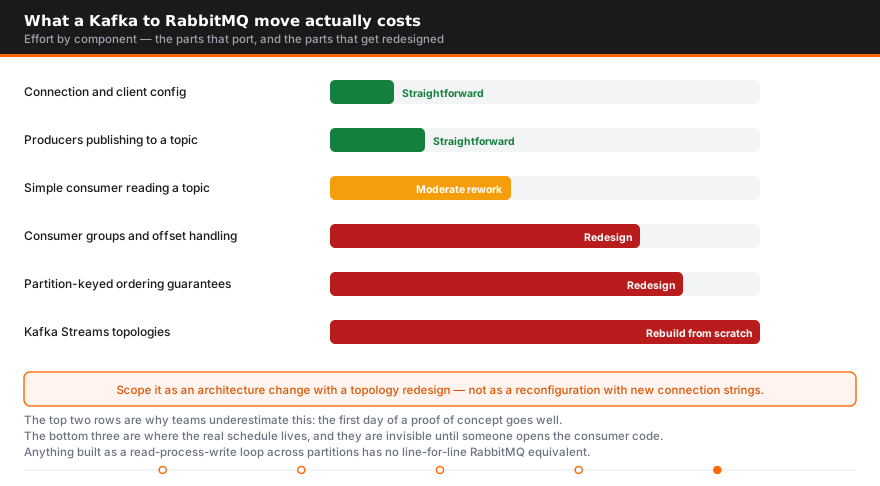
- Connection configuration and producers are genuinely easy. A producer that publishes to a topic becomes a publisher that publishes to an exchange. The mental model transfers and so does most of the code shape.
- Simple consumers are moderate work. A consumer reading a topic becomes a consumer on a queue, but acknowledgement moves from client-tracked offsets to broker-tracked acks, and prefetch replaces poll sizing.
- Consumer groups and offset handling are a redesign. In Kafka the consumer owns its position and can rewind. In RabbitMQ the broker tracks delivery state per message. If your consumers rewind offsets as an operational tool, that behavior needs a stream rather than a queue — and if it needs a queue for the per-message features, the rewind capability has to be replaced with something else entirely.
- Partition-keyed ordering is a redesign. Kafka guarantees order within a partition, and applications lean on that. RabbitMQ's equivalent is single active consumer on a queue, which keeps exactly one consumer active with automatic failover. It works well, and it is not a drop-in substitution — you have to decide which flows genuinely need ordering, because applying it everywhere throttles throughput.
- Kafka Streams topologies are a rebuild. Joins, windowing, and aggregations have no RabbitMQ equivalent. If you have a serious stream processing layer, that is a strong signal to keep Kafka for that layer rather than migrate it.
The Sequence That Works
Migrations that go badly usually go badly in the same way: producers move first, and consumers are discovered to be harder than expected while traffic is already split.
- Inventory consumers before anything else. Not topics, not volume — consumers. Which ones rewind offsets? Which depend on partition ordering? Which are Kafka Streams applications? That inventory is your actual project plan, and it is usually the first time anyone has written it down.
- Design the topology, do not translate it. A Kafka topic is not an exchange and a partition is not a queue. Decide per flow: quorum queue for work that must not be lost, stream for replayable history, classic queue for transient churn. Our classic vs quorum queues guide covers that choice.
- Bridge, with an end date. Run both systems connected during the transition. Set the date when the bridge comes down before you build it — open-ended coexistence is how organizations end up permanently running two platforms nobody chose.
- Move consumers before producers. Prove the new path under real traffic while the old path is still authoritative. Reversing this order means discovering consumer problems during cutover.
- Handle ordering and duplicates across the bridge explicitly. Treat it as design work, not as something the bridge takes care of. It does not.
The Honest Answer for Most Teams
A full migration off Kafka is the right answer less often than a split is.
The pattern that works repeatedly: RabbitMQ takes the operational messaging — task queues, request/reply, device connectivity, per-tenant isolation, anything needing per-message TTL, priorities or dead-lettering — and Kafka keeps the analytics and event-history layer where tiered storage, log compaction and the processing ecosystem earn their cost. Bridging the two is straightforward in either direction.
That is not indecision. It is recognizing that these systems are good at different things, and that the expensive mistake is forcing one to do the other's job in application code.
If you want a migration scoped against your actual consumer inventory rather than an estimate, talk to AceMQ. We run both platforms in production, and the first thing we will tell you is whether the move is worth doing at all.
If the answer is to migrate, the RabbitMQ migration guide sequences the work from inventory to cutover, with the Kafka-specific semantic mapping at step three.
If the question behind this article is architecture rather than a live incident — partition strategy, sizing, security design, a migration — AceMQ's Kafka consulting puts a named senior engineer on it. For a cluster your team runs and wants covered when it breaks, 24/7 Kafka support is the contract.
FAQ
Can you migrate from Kafka to RabbitMQ?
Yes, but it is not a drop-in replacement. Connection configuration and simple publishing port quickly. Consumer groups, offset management, partition-keyed ordering and anything built on Kafka Streams have no line-for-line equivalent and need redesign. Scope it as an architecture change with a topology rebuild.
What is the hardest part of a Kafka to RabbitMQ migration?
Consumer-side semantics. A Kafka consumer group assigns one consumer per partition and tracks its own offset; a RabbitMQ queue pushes to competing consumers with broker-tracked acknowledgement. Logic depending on partition-keyed ordering, on replaying from a stored offset, or on read-process-write loops has to be redesigned. Kafka Streams topologies are effectively a rebuild.
Why would anyone move from Kafka to RabbitMQ?
Usually because the workload was never really a log. Teams that adopted Kafka for everything often rebuild queue behavior — retries, dead-lettering, priorities, expiry, request/reply — in application code. Priced against a broker that provides those natively, the case makes itself. The second driver is durability: quorum queues replicate and fsync before confirming, which Kafka does not do by default.
How long does a Kafka to RabbitMQ migration take?
It depends on consumer complexity, not message volume. A handful of straightforward publish and subscribe flows can move in weeks; an estate with consumer groups, keyed ordering and stream processing topologies is a multi-quarter program. Inventory consumers first — the producer side rarely sets the schedule.
Can RabbitMQ and Kafka run side by side during a migration?
Yes, and it is usually the right approach. Bridge the two, move consumers before producers so the new path is proven under real traffic, and run the bridge phase with a defined end date. Open-ended coexistence is how a migration becomes a permanent second platform nobody chose.
Should I migrate off Kafka if it is working?
No. There is no prize for migrating a working event streaming platform. The migrations worth doing are the ones where the workload is a poor fit — queue semantics rebuilt in application code, per-message handling Kafka cannot provide, or a durability requirement Kafka does not meet by default.

Author
Talk to an engineer
Need a hand with Kafka?
Senior engineers who run it in production. Get a quote or a free consultation, no sales pitch.
Go deeper on Kafka
- GuideThe Kafka Operations GuideRead the guide
- GuideThe Kafka Buyer's GuideRead the guide
- GuideThe Kafka Monitoring and Alerting GuideRead the guide
- GuideThe Kafka Migration GuideRead the guide
- GuideKafka for AI Agents Without Confluent CloudRead the guide
- ComparisonNATS vs Kafka: Core NATS, JetStream and Kafka ComparedSee the comparison
- ComparisonMosquitto vs Kafka: MQTT Broker or Event Log?See the comparison
- ComparisonKafka vs Kinesis ComparedSee the comparison
- ComparisonManaged Kafka Options ComparedSee the comparison
- ComparisonKafka BYOC (Bring Your Own Cloud) Options ComparedSee the comparison
- ComparisonConfluent Alternatives After the IBM AcquisitionSee the comparison


