
On this page
The comparison most teams are working from is about a decade out of date. "Kafka for streaming, RabbitMQ for queuing" described the world of 2015 accurately and describes 2026 poorly. RabbitMQ has had streams since 3.9. Kafka added share groups that give it queue-like consumption. Both systems now cover both jobs, which means the decision has moved from what each one can do to what each one does well under load, and what it costs you operationally.
The RabbitMQ core team recently published a genuinely excellent technical comparison of RabbitMQ and Kafka, and it is the best feature-level reference on the subject. This piece is not a substitute for it. It is the other half: what we see when we are the ones running these systems in production for customers, including the places where RabbitMQ genuinely loses and the official documentation, understandably, is not going to lead with.
AceMQ supports both RabbitMQ and Apache Kafka in production for enterprise customers. That gives us an unusual vantage point — we have no incentive to pretend either message broker is universally correct, because we get called either way.
Why the Old "Kafka for Streaming, RabbitMQ for Queuing" Split Stopped Being True
The original split was real. Kafka was built as a distributed commit log — an event streaming platform for high-volume real-time data pipelines, where the durable data stream is the primary abstraction. RabbitMQ was built as an AMQP message broker for routing discrete units of work between applications. Choosing between the two messaging systems used to be a question of which shape your problem was.
Two changes collapsed that distinction. RabbitMQ streams arrived as a persistent, replayable, append-only log with consumers reading from an offset — the same primitive Kafka is built on. And Kafka share groups arrived to let multiple consumers pull from a topic without partition-exclusive assignment, which is the behavior people mean when they say they want a queue.
So both boxes are ticked on paper. The trap is assuming that ticking the box means parity. A RabbitMQ stream is not a worse Kafka topic and Kafka share groups are not a worse RabbitMQ queue — but neither is a straight substitute for the thing it imitates, and the gaps are exactly where production incidents come from.
Where Kafka and RabbitMQ Now Genuinely Agree
On the streaming side, the two architectures have converged to a striking degree, and RabbitMQ is open about having borrowed proven design decisions. Both systems batch messages as their unit of work. Both use a single binary format from producer through disk to consumer so no re-encoding happens in the middle. Both use zero-copy reads via sendfile. Both lean on the operating system page cache rather than holding messages in application heap. Both support publisher-side deduplication. Both now use Raft for cluster metadata — KRaft in Kafka, Khepri in RabbitMQ.
The practical consequence is that streaming throughput is no longer a meaningful differentiator. RabbitMQ streams and Kafka topics both reach several million messages per second on comparable hardware. If someone tells you to pick Kafka over RabbitMQ because RabbitMQ cannot handle volume, they are quoting a benchmark from a version that is many years retired.
This matters for how you read older comparisons. Most of the "Kafka vs RabbitMQ" content still circulating was written before streams existed, and its performance conclusions were correct at the time and are wrong now.
The Durability Difference Most Comparisons Skip
This is the single most consequential technical difference between the two systems, and it is almost never covered in general comparison articles.
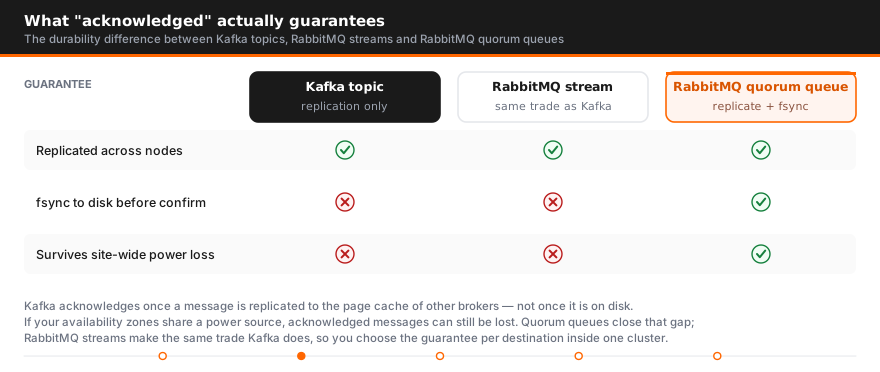
Kafka, by default, relies on replication alone. When a broker acknowledges your message, that message is in the page cache of multiple brokers — it has not necessarily been flushed to disk. Replication across nodes is a strong risk-reduction mechanism and it covers the common failure case of losing one machine. What it does not cover is correlated failure. If your availability zones share a power source, or you are on-premise in a single facility, a power event can take acknowledged messages with it.
RabbitMQ quorum queues replicate and fsync to disk before confirming to the publisher. The message is durably on disk on a quorum of nodes before your application is told it was accepted. That is a materially stronger guarantee, and for payments, orders, and anything with a regulatory paper trail it is often the deciding factor.
The nuance worth understanding: RabbitMQ streams make the same trade Kafka does. Streams rely on replication and the page cache and do not fsync before confirming. So this is not "RabbitMQ is safer than Kafka" — it is that RabbitMQ gives you the choice per destination. Route the messages you cannot lose through a quorum queue, and route high-volume telemetry through a stream, in the same cluster.
The reason RabbitMQ can afford this is architectural. In Kafka, fsync is expensive because it happens per partition. In RabbitMQ, quorum queues share a write-ahead log, so the cost of a flush is amortized across many queues rather than paid separately by each one. That is what makes it practical to have many queues, replication with fsync, and throughput at the same time — the three properties Kafka generally makes you choose two of.
Where RabbitMQ Wins: Per-Message Control and Broker-Side Routing
The deepest philosophical difference is what a message is. In RabbitMQ, a message is an independent item of work with its own lifecycle. In Kafka, a message is a fixed position inside a shared log, and its fate is tied to its neighbors.
That difference is why RabbitMQ quorum queues run Raft consensus down to the individual message — including delivery state, which message is checked out to which consumer, and how many credits that consumer holds. During a leader failover, the new leader resumes with that state intact. Kafka's semantics are weaker here: recovery generally means redelivering a batch, which is fine for at-least-once processing but is not the same guarantee.
Practically, it produces a per-message toolkit that has no Kafka equivalent:
- Per-message TTL — individual messages expire on their own schedule.
- Strict priority levels — urgent work overtakes queued backlog instead of waiting behind it.
- Dead-letter routing — failed messages route somewhere useful automatically rather than blocking or vanishing.
- Delays and delayed retries — backoff without an external scheduler.
- Broker-side message interceptors — logic that runs on the broker rather than in every client.
Kafka share groups deliver queue-like consumption, but they do not bring per-message TTL, priorities, or dead-letter routing with them, and head-of-line blocking is not fully eliminated. If your workload is genuinely a task queue with SLAs and failure handling, this gap is the whole decision.
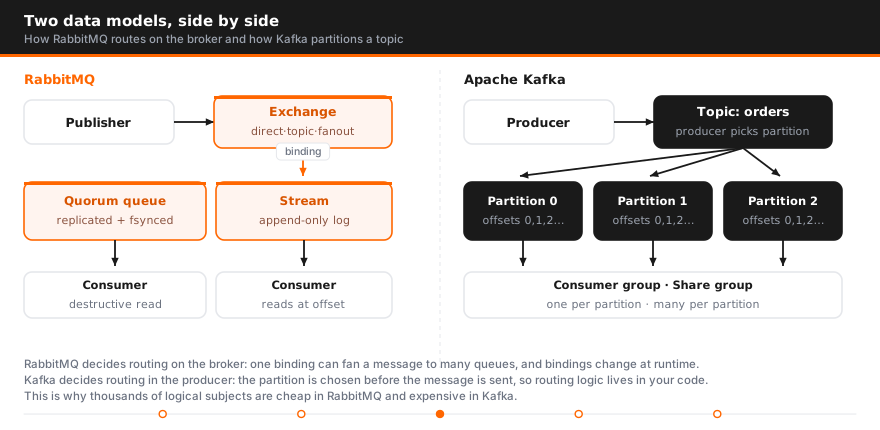
The second RabbitMQ advantage is broker-side routing and filtering. Exchanges, bindings, and queues let the broker decide where a message goes, and bindings can be reconfigured at runtime without redeploying publishers. In Kafka, the producer decides which partition it writes to, so routing logic lives in application code. A topic pattern like orders.# is one binding in RabbitMQ; in Kafka it is either multiple physical topics or client-side filtering that pulls data across the network only to discard it. That difference compounds badly when you have thousands of logical subjects rather than a dozen.
Add to that multi-protocol support — AMQP 1.0, AMQP 0-9-1, MQTT, STOMP, and JMS against one cluster, with documented header conversion between them — and RabbitMQ covers event-driven architectures where IoT devices, Java applications, and microservices all need the same message broker. Kafka speaks the Kafka protocol.
Where RabbitMQ Actually Loses
This is the section vendor documentation cannot write, and it is the part worth reading twice if you are making a real decision.
There is no sharding at the queue level
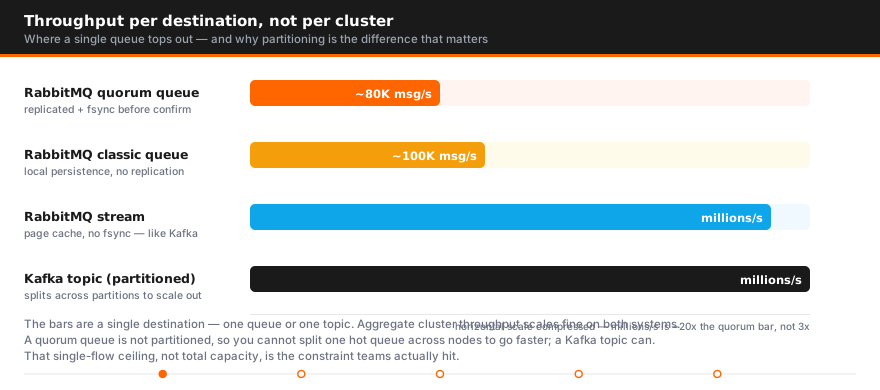
A quorum queue is not partitioned. Its throughput ceiling sits somewhere around 80,000 messages per second with replication and fsync, and you cannot split a single queue across nodes to go faster. Aggregate cluster throughput scales fine — spread work across many queues and RabbitMQ handles it comfortably. But one extremely hot flow through one specific destination is a real ceiling, and it is the constraint we most often have to walk customers through. Kafka splits a topic across partitions precisely to avoid this, and for a genuinely single-stream firehose that architecture wins.
The workaround is application-level sharding — publish across N queues with a routing key that distributes load — and it works, but it is your design problem to solve rather than something the broker does for you.
Cloud elasticity and rescaling are more deliberate
Growing a Kafka cluster means adding brokers and rebalancing partitions. Growing a RabbitMQ cluster means thinking about quorum queue replica membership: which queues have replicas where, how you shift them, and how the quorum behaves while you do it. It is well-defined and it is not dangerous, but it is not the elastic scale-out story that cloud-native teams expect by default.
For context on real-world topology: across the clusters we support, three nodes is the common baseline, five is very well represented, seven shows up occasionally, and we have seen a thirteen-node cluster in the wild — that one built to run many concurrent processing paths horizontally rather than for any quorum-related reason. Most teams do not need to go past five, but the ones that want true elastic rescaling should know it takes planning.
Three capabilities Kafka has and RabbitMQ does not
- Tiered storage. Kafka can offload older log segments to object storage, which makes very long retention economical. RabbitMQ has no equivalent today.
- Log compaction. Retaining only the latest value per key is native to Kafka. You can build it yourself on RabbitMQ, but you are building it.
- The stream processing ecosystem. Kafka Streams, plus the connector and analytics ecosystem around it, is substantially more mature. If your team is doing stateful joins, windowing, and aggregations as a first-class part of the product, that ecosystem is a genuine reason to choose Kafka and it is not close.
If your requirements land on any of those three, the honest recommendation is to use Kafka, and we will tell you so.
Push vs Pull, and Why It Shows Up in Your Latency Numbers
RabbitMQ classic and quorum queues use a push model: the broker delivers to consumers up to a prefetch limit, so a message that arrives on an idle queue reaches a consumer immediately. Kafka uses a pull model: consumers poll and manage their own offset.
For background jobs and request/reply work, the push model is why RabbitMQ typically posts lower end-to-end latency — there is no poll interval standing between arrival and delivery. For replay, reprocessing, and consumers that need to move independently through history, the pull model is cleaner, because the offset belongs to the consumer rather than the broker tracking per-consumer delivery state.
RabbitMQ streams are the exception and behave like Kafka: consumers attach at an offset and read forward, and the data stays available for replay after consumption. This is the single most common misconception we correct — RabbitMQ does not delete a message the moment somebody reads it if you are using a stream. That was true of classic queues and it shaped a generation of assumptions.
Migrating Between Them Is an Architecture Change, Not a Reconfiguration
Teams evaluating a switch usually underestimate this, and it is the most expensive assumption in the whole comparison.
Kafka to RabbitMQ is not plug-and-play. Consumer groups, partition-keyed ordering, and offset management have no line-for-line equivalent. Anything built as a read-process-write loop across partitions, and anything using Kafka Streams, has to be redesigned rather than reconfigured. Migrations that go well are scoped from the start as an architecture change, with the topology rebuilt around exchanges, bindings, and the right queue type per flow.
The direction of travel matters too, and there is a clear asymmetry in what we see:
- Teams already running RabbitMQ who need streaming are the straightforward case. Streams are in the broker they already operate, their team already knows the tooling, and there is no second platform to staff.
- Teams already running Kafka who need real messaging semantics are the interesting case. When they look closely at total cost, at the operational overhead of the cluster, and at what fsync-before-confirm durability is actually worth to them, the case for RabbitMQ usually makes itself. When they do not look that far, they tend to build increasingly elaborate workarounds on top of Kafka for problems a message broker solves natively.
If you are in the second group, the useful exercise is not a feature checklist. It is pricing out what you are currently spending to make Kafka behave like a queue.
A Decision Framework That Holds Up
Matching each use case to the right system, based on what actually determines the outcome rather than on category labels:
| Task queues and background jobs | RabbitMQ — per-message acknowledgement, retries, dead-lettering |
| Payments, orders, regulated workloads | RabbitMQ — quorum queues replicate and fsync before confirming |
| Priorities and per-message SLAs | RabbitMQ — no Kafka equivalent |
| Request/reply between microservices | RabbitMQ — low latency, push delivery, direct reply-to |
| IoT and device connectivity | RabbitMQ — native MQTT at scale on the same cluster |
| Many logical subjects or per-tenant isolation | RabbitMQ — broker-side routing, virtual hosts, thousands of cheap queues |
| Event streaming with replay | Either — designs have converged; pick the one you already run |
| Website activity tracking, logs, telemetry | Either — throughput is comparable at this point |
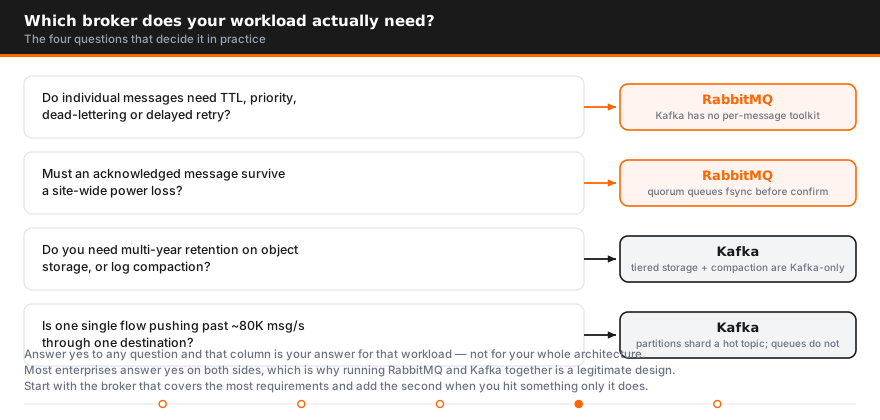
| Extreme throughput through one single flow | Kafka — partitioning splits a hot topic; queues do not shard |
| Multi-year retention on cheap storage | Kafka — tiered storage to object storage |
| Latest-value-per-key semantics | Kafka — native log compaction |
| Stateful stream processing and analytics | Kafka — Kafka Streams and the surrounding ecosystem |
The pattern in that table is not "RabbitMQ wins." It is that RabbitMQ wins on message semantics and operational breadth, Kafka wins on log economics and the processing ecosystem. Those are different questions, and most teams know which one they are actually asking once it is put that way.
The same split applies when the consumers are AI agents and LLM workers rather than services. Our RabbitMQ vs Kafka vs NATS for AI agents comparison works through that case.
Running Both Is a Legitimate Answer
The framing of "RabbitMQ vs Kafka" implies a winner, and plenty of mature architectures simply do not have one. A pattern we see work repeatedly in event-driven systems: RabbitMQ carries operational messaging — task queues, request/reply, device connectivity, per-tenant isolation — while Kafka carries the analytics and event-history layer where tiered storage and stream processing pay for themselves. That is a common use case for running both.
The cost of that split is real: two platforms to staff, monitor, patch, and secure. It is worth paying when both sets of requirements are genuinely present, and it is worth avoiding when one system would cover everything. Our general advice to teams starting fresh is to start with the message broker that covers the widest range of your requirements and add the second system when you hit something only it can do — which, for most enterprise workloads, means starting with RabbitMQ and adding Kafka if and when the log economics or the processing ecosystem become the binding constraint.
If you are weighing this decision against a real workload rather than in the abstract, that is the conversation we have most often. AceMQ runs both platforms in production for enterprise customers — see our RabbitMQ services and our Kafka support, or talk to us about which one fits your architecture. We are equally happy to tell you the answer is Kafka.
Two adjacent comparisons: Kafka versus Pulsar if you are still choosing a streaming platform, and moving from Kafka to RabbitMQ if you concluded the fit was wrong.
RabbitMQ vs Kafka for scaling: what actually scales, and what does not
"Which one scales better" is the question we hear most, and it is the wrong question. Both brokers scale, but along different axes, and the thing you add when you need more capacity is different in each. Get that unit right and either one will carry more than most enterprises will ever push through it.
The unit of scale. In Kafka, the unit is the partition. A topic is a set of partitions, each an ordered log with one leader, and a topic's throughput is the sum of its partitions. Add partitions and you add parallelism, at the cost of ordering across the topic as a whole and a rebalance for every consumer group attached to it.
In RabbitMQ, the unit is the queue. A quorum queue is one Raft group with one leader on one node. It is replicated for safety, not sharded for throughput, so a single quorum queue tops out at what one node's CPU and disk can do for that queue. Streams and super streams are the partitioned answer: a super stream is a set of stream partitions with the same shape and the same tradeoffs as a Kafka topic, and we cover that comparison in full in RabbitMQ streams vs Kafka. For classic workloads that do not need a replayable log, the consistent-hash exchange shards traffic across many queues by routing key, which is how you spread one hot flow across nodes without touching producers.
What scales linearly and what hits a wall. In RabbitMQ, many queues scale close to linearly across a cluster because each queue's leader can sit on a different node. One hot queue does not. That is the wall we see most often: everything routed through one queue, one node saturated, the rest of the cluster idle. The fix is design, not hardware.
In Kafka, throughput scales with partition count, but consumers cannot scale past it. A consumer group with more members than partitions leaves the extras idle, and a very high partition count per broker raises leader election time, open file handles, and recovery time after a restart. Partitions are cheap until they are not.
Both have per-node limits that have nothing to do with message rate. RabbitMQ counts connections and channels per node, and thousands of chatty clients each holding several channels will exhaust memory and scheduler time long before message throughput is the problem. Raft replication on quorum queues costs a network round trip and a disk write on a majority of replicas per batch, so a quorum queue is slower than a classic queue by design, and five replicas are slower than three. Choosing between the two for a given workload is covered in classic vs quorum queues.
- Horizontal scale of brokers. Adding a Kafka broker does nothing by itself. You reassign partitions to it, and the reassignment copies data across the network while the cluster keeps serving. Adding a RabbitMQ node also does nothing by itself. Existing queues do not move; their leaders stay where they were declared. New queues can be placed on the new node, quorum queue membership can be grown to include it, and leaders can be rebalanced, but none of it is automatic. Both need an operator with a plan, and we would rather that plan exist before the incident bridge does.
- Scaling consumers. RabbitMQ uses competing consumers: attach more consumers to a queue and the broker spreads deliveries across them, bounded by prefetch. No rebalance, no pause, no coordination protocol. This is why RabbitMQ handles bursty worker pools so well. Kafka scales consumers through consumer group rebalance, which redistributes partitions and briefly stops consumption for the group. Cooperative rebalancing softens that, but the ceiling is still the partition count. Single active consumer on RabbitMQ gives strict ordering on one queue at the cost of parallelism, which is the same tradeoff Kafka makes per partition.
- Operational cost. Kafka's scale costs show up in partition planning, reassignment, and consumer lag tooling. RabbitMQ's show up in queue placement, connection hygiene, and memory watermarks. Neither is free. Sizing either cluster is its own topic and lives in our HA and cluster sizing FAQ, so we will not restate it here.
- Verdict. Kafka scales a small number of very high volume ordered streams better. RabbitMQ scales a large number of moderate flows with routing better. Both scale well past most enterprise workloads. In our engagements, the ceiling a client hits is almost always a design ceiling, one hot queue or one giant topic, not the broker's. We run both in production for enterprise clients, and the fix is usually re-partitioning the workload rather than switching brokers. See our RabbitMQ consulting and Kafka consulting.
FAQ
What is the real difference between RabbitMQ and Kafka in 2026?
The honest answer is no longer "Kafka for streaming, RabbitMQ for queuing." RabbitMQ has had streams since 3.9, and Kafka added share groups for queue-like consumption. Both systems now do both jobs. The real differences are durability defaults (RabbitMQ quorum queues replicate and fsync before confirming; Kafka replicates but does not fsync by default), per-message control (TTL, priorities, dead-letter routing, and delays exist in RabbitMQ and not in Kafka), broker-side routing, and protocol support. Kafka's remaining structural advantages are tiered storage, log compaction, and a far larger stream processing ecosystem.
Why use RabbitMQ instead of Kafka?
Choose RabbitMQ when individual messages matter as independent units of work: when you need per-message TTL, strict priority levels, dead-letter routing, or delayed retries; when you need broker-side routing so publishers do not have to know consumer topology; when you need protocols beyond one (AMQP 1.0, AMQP 0-9-1, MQTT, STOMP, JMS); when you need thousands of logical queues rather than a handful of large topics; or when losing an acknowledged message to a power failure is unacceptable and you need fsync-before-confirm durability.
Is RabbitMQ a push or pull model?
RabbitMQ classic and quorum queues are push-based: the broker delivers messages to consumers up to a prefetch limit, which is what gives it low latency on task queues. Kafka is pull-based: consumers poll partitions and track their own offset. RabbitMQ streams are the exception and behave more like Kafka, with consumers reading from a chosen offset. The push model is why RabbitMQ generally shows lower end-to-end latency for background jobs, and the pull model is why Kafka handles replay and reprocessing more naturally.
What is RabbitMQ's throughput ceiling compared to Kafka?
The number that matters is per-destination, not aggregate. A single quorum queue with replication and fsync lands in the neighborhood of 80,000 messages per second, classic queues somewhat higher, and RabbitMQ streams reach several million — comparable to Kafka, because the streaming designs converged. Aggregate cluster throughput scales fine across many queues. The constraint is that a quorum queue is not sharded, so one extremely hot single flow cannot be split across nodes the way a Kafka topic splits across partitions.
Can you migrate from Kafka to RabbitMQ?
Yes, but it is not a drop-in replacement and anyone who tells you otherwise has not done one. Kafka's consumer-group and offset model, partition-keyed ordering, and any Kafka Streams topology have no line-for-line equivalent. Applications built around read-process-write loops or partition-level ordering need rework, not reconfiguration. Migrations that go well are the ones scoped as an architecture change with the messaging topology redesigned around exchanges and queues.
Do Kafka and RabbitMQ work together?
Frequently, and it is often the right answer. A common production pattern uses RabbitMQ for operational messaging — task queues, request/reply, per-tenant isolation, device connectivity — and Kafka for the analytics and event-history layer where tiered storage, log compaction, and the stream processing ecosystem earn their keep. Bridging the two is straightforward in either direction. Running both is a legitimate architecture, not a failure to decide.
Which is easier to operate, Kafka or RabbitMQ?
RabbitMQ is generally easier to stand up and monitor: a management UI and Prometheus endpoint ship in the box, Windows is supported, and the Erlang runtime isolates faults so a misbehaving queue or connection crashes alone rather than taking a node with it. Kafka requires a JMX exporter for metrics and a third-party or commercial UI, and Windows is not meaningfully supported. Kafka's operational story improved considerably with KRaft removing the ZooKeeper dependency. Where RabbitMQ is harder is elastic rescaling — changing quorum queue replica membership as a cluster grows is more deliberate than adding Kafka brokers and rebalancing partitions.
Which scales better, RabbitMQ or Kafka?
Neither wins outright. Kafka scales a few very high volume ordered streams better, because a topic's throughput is the sum of its partitions and partitions spread across brokers. RabbitMQ scales many moderate flows better, because each queue can lead on a different node and the broker routes between them without producer changes. Both exceed what most enterprise workloads need. In our engagements the limit is almost always one hot queue or one oversized topic, which is a design problem, and fixing the design costs far less than changing brokers.
How do you scale RabbitMQ horizontally?
Add nodes, then give them work, because existing queues do not migrate on their own. Spread queues so each node leads its share, use the consistent-hash exchange to shard a hot classic workload across queues, and use super streams when you need partitioned, replayable logs. Grow quorum queue membership onto new nodes deliberately and rebalance leaders afterward. Keep connections and channels per node in check with client-side pooling. Consumers scale by adding competing consumers to a queue with a sensible prefetch. Node counts and replica factors are covered in our HA and cluster sizing FAQ.

Author
Talk to an engineer
Need a hand with Kafka?
Senior engineers who run it in production. Get a quote or a free consultation, no sales pitch.
Go deeper on Kafka
- GuideThe Kafka Operations GuideRead the guide
- GuideThe Kafka Buyer's GuideRead the guide
- GuideThe Kafka Monitoring and Alerting GuideRead the guide
- GuideThe Kafka Migration GuideRead the guide
- GuideKafka for AI Agents Without Confluent CloudRead the guide
- ComparisonNATS vs Kafka: Core NATS, JetStream and Kafka ComparedSee the comparison
- ComparisonMosquitto vs Kafka: MQTT Broker or Event Log?See the comparison
- ComparisonKafka vs Kinesis ComparedSee the comparison
- ComparisonManaged Kafka Options ComparedSee the comparison
- ComparisonKafka BYOC (Bring Your Own Cloud) Options ComparedSee the comparison
- ComparisonConfluent Alternatives After the IBM AcquisitionSee the comparison


