On this page
Support is now bundled into every VMware subscription. That is genuinely simpler — and it is also why people discover what their support does and does not cover during an incident rather than during procurement.
Under the perpetual model, Support and Subscription was a separate line item you could let lapse. Under subscription it is included and inseparable. It is no longer a lever for reducing a renewal number, which is one reason renewal quotes look bigger than the license figure people remember.
Support comes with the subscription, so the VMware renewal quote is where you confirm which support level you are buying.
Severity Levels: What They Actually Mean
Severity is a measure of business impact, not urgency of feeling. It determines the response commitment you get, so setting it accurately matters more than setting it high.
- Severity 1 — critical. Production down, no workaround. Fastest response, and usually a requirement that you stay available to work the case continuously.
- Severity 2 — major. Significant impairment, but a workaround exists. Production is degraded rather than stopped.
- Severity 3 — minor. A partial or non-critical issue. Normal business-hours handling.
- Severity 4 — informational. A question, a documentation request, a how-to.
Opening everything at Severity 1 works exactly once. After that it costs you credibility on the case that genuinely needs it.
| Severity | What it means | What it commits |
|---|---|---|
| 1 — Critical | Production down, no workaround | Fastest response; expect to stay available continuously |
| 2 — Major | Significant impairment, workaround exists | Production degraded rather than stopped |
| 3 — Minor | Partial or non-critical issue | Normal business-hours handling |
| 4 — Informational | A question or documentation request | No urgency implied |
Response Time Is Not Resolution Time
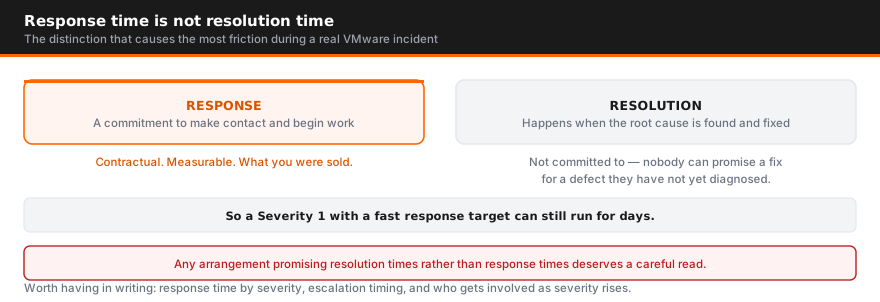
This is the misunderstanding that causes the most friction during real incidents.
A response target is a commitment to make contact and begin work within a stated window. A resolution is what happens when the root cause is found and fixed, and no vendor commits to a resolution time for a defect they have not yet diagnosed — because it is not a promise anyone can honestly make.
So a Severity 1 with a fast response target can still run for days. The clock you were sold is the clock to first contact. If you are evaluating any support arrangement — vendor or partner — and it promises resolution times rather than response times, read that clause carefully before relying on it.
The Gap Vendor Support Does Not Cover
Vendor support answers one question well: is the product behaving as designed? Outside that boundary sits most of what actually causes incidents.
- Architecture and design. Whether your cluster layout, storage design or DR topology is sound. Support will confirm the product works; it will not tell you that you built the wrong thing.
- Capacity and sizing. Whether you have enough headroom, and what your core count should be at the next hardware refresh.
- Migrations and upgrades. Planning and executing them. Support helps when something breaks, not while you plan.
- Third-party integrations. Backup, monitoring, storage, security tooling. Each vendor supports its own product, and the seam between them is where cases stall.
- Workload-specific tuning. Performance of your applications on your configuration.
- Licensing. What you should be buying, whether your core count is right, and what a renewal should cost. Support does not answer this and is not meant to.
What a Partner Adds
Not a replacement for vendor support — the vendor is the only route to a product defect fix, and any partner claiming otherwise is overselling.
What a partner adds is context and continuity. Someone who already knows your estate does not need re-briefing at 2am. They can tell you whether a problem is a defect or your configuration before you open a case, which is the difference between a case that moves and a case that bounces. They cover the architecture, sizing, migration and licensing ground that sits outside the vendor boundary. And on escalations, a partner with a direct Broadcom relationship can push a case harder than a customer opening a ticket cold.
AceMQ supports VMware estates and quotes VMware licensing as a Broadcom partner. If you want your renewal sized correctly and someone who knows the environment when it matters, get in touch.
| The gap | Where it gets answered |
|---|---|
| Is my core count and renewal priced correctly? | How to get a VMware renewal quote |
| Can I prove my license position? | VMware license audit readiness |
| Should we even renew? | Renew or migrate: the honest comparison |
| Who is allowed to sell to us? | Where to buy VMware licenses |
Keep going
If the question is support without a subscription: third-party support vs a subscription.
FAQ
Is support included with a VMware subscription?
Yes. Entitlement and support are bundled, unlike the perpetual model where Support and Subscription was separable. It is also no longer a lever for reducing a renewal number.
What do the severity levels actually mean?
Business impact: 1 is production down with no workaround, 2 is significant impairment with a workaround, 3 is minor, 4 is a question. The level drives the response commitment.
Is a response time the same as a fix time?
No. Response is a commitment to make contact and begin work. Nobody commits to resolving a defect they have not yet diagnosed.
What does vendor support not cover?
Architecture, capacity planning, migrations and upgrades, third-party integrations, workload-specific tuning, and licensing decisions.
What does a partner add?
Context and continuity — knowing the estate before the incident, filtering defect from configuration before a case is opened, covering the licensing and design ground, and escalating with a direct vendor relationship.
Do I need both?
Usually. The vendor is the only route to a defect fix; the partner covers the ground between "working as designed" and "our environment is healthy".

Author
Go deeper on VMware
- GuideThe VMware Renewal Guide, 2026Read the guide
- ComparisonVMware Renewal Options ComparedSee the comparison
- Comparison1-Year vs 3-Year vs 5-Year VMware SubscriptionsSee the comparison
- ComparisonThird-Party VMware Support vs a Broadcom SubscriptionSee the comparison
- ComparisonVMware Renewal Partner Types ComparedSee the comparison
- ResearchVMware Renewal Pricing in 2026: What 37 Quotes ShowRead the research